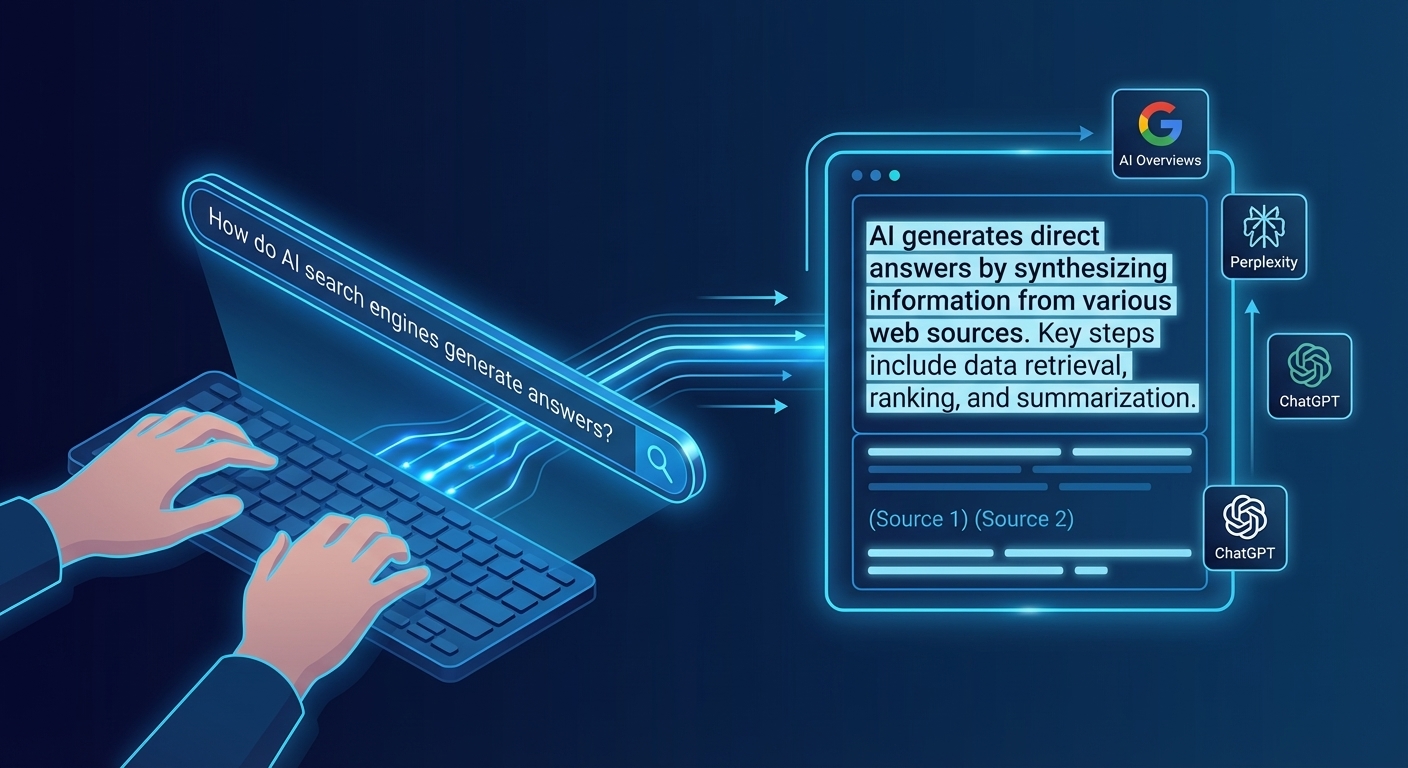
Search behavior has shifted. A growing share of queries now return a direct answer at the top of the page, or inside an AI interface, with no click required. Google AI Overviews, Perplexity, ChatGPT, Claude, and Bing Copilot all function as answer engines: systems that synthesize information and surface a response rather than a ranked list of links.
Brands that rely on organic traffic now face a specific structural problem: traditional ranking signals matter less when the engine never sends users to your site. What matters instead is whether your content is the source the engine cites.
Answer engine optimization (AEO) is the discipline that addresses this. This guide explains what AEO is, how it differs from SEO and GEO, which content formats perform best, what mistakes to avoid, and how to measure whether your content is being cited by AI systems.
The useful way to apply AEO is diagnostically. If your content is missing from AI answers, the problem is usually one of three things: access, understanding, or authority. That is a better starting point than chasing a generic AEO checklist.
Key Takeaways
- → Answer engine optimization structures content so AI systems can extract and cite it as a direct answer.
- → AEO works at the passage level, not the page level. A single well-structured FAQ block can earn citations.
- → AEO complements SEO rather than replacing it. Strong SEO authority still improves citation likelihood.
- → The highest-leverage changes are answer-first openings, question-based headings, schema markup, and concise atomic paragraphs.
- → Measure AEO with Search Console snippet data, manual prompt testing, and tools like Profound.
- → Brands absent from AI answers lose share of voice even if their traditional rankings still hold.
What Is Answer Engine Optimization?
Answer engine optimization (AEO) is the practice of structuring content so that AI-powered answer engines can extract, understand, and cite it as a direct response to user queries. AEO uses question-based headings, concise upfront definitions, structured lists, comparison tables, and schema markup such as FAQPage and HowTo to signal extractability to AI systems.
That definition covers the core of it. But understanding why AEO is a distinct discipline, not just a SEO tactic, requires understanding what answer engines actually do.
Traditional search engines rank documents. Answer engines generate responses. When a user asks ChatGPT or Perplexity a question, the system does not return ten blue links. It synthesizes an answer from multiple sources and, where possible, attributes that answer to a specific source. The selection criteria for which sources get cited are fundamentally different from the criteria for which pages rank on page one.
HubSpot's overview of AEO best practices identifies the structural markers that make content extractable: question-based headings, 40-60 word definition blocks at the opening of each major section, bulleted lists for multi-part answers, and schema markup that explicitly labels content type. CXL's comprehensive AEO guide adds that content must map directly to real user questions, not just contain keywords, and that the format of your answer should mirror the format of the question.
Platforms that now qualify as answer engines include:
- → Google AI Overviews at the top of Google results pages
- → Perplexity with source-cited responses
- → ChatGPT with web browsing for real-time retrieval
- → Claude for sourced synthesis
- → Bing Copilot in Microsoft's search experience
Each of these systems uses different retrieval and ranking mechanisms, but all share one requirement: the source content must be clearly structured, factually accurate, and answerable at the passage level, not just the page level. Our ChatGPT search guide shows how that translates into platform-specific citation tactics. Marcel Digital's breakdown of AEO frames this as the core structural difference: SEO optimizes pages, AEO optimizes passages.
AEO vs. SEO vs. GEO
These three terms are sometimes used interchangeably, but they describe different objectives, different signals, and different content strategies.
Generative engine optimization (GEO) refers to optimizing content for generative AI systems broadly, including large language models that synthesize content during training or retrieval. For a full treatment of GEO, see our guide to generative engine optimization .
AEO is narrower: it focuses specifically on getting cited in real-time answer interfaces. Think of AEO as the applied, operational layer of GEO, the tactics you execute on published content to improve citation likelihood in live AI search tools.
| Dimension | SEO | AEO | GEO |
|---|---|---|---|
| Goal | Rank in organic search results | Get cited as a source in AI answer responses | Appear in generative AI outputs broadly |
| Primary signal | Backlinks, on-page optimization, crawlability | Passage extractability, schema markup, question-answer match | Entity recognition, training data presence, authority signals |
| Content format | Long-form pages optimized for keyword density and dwell time | Answer-first passages, FAQ sections, structured lists, HowTo schemas | Authoritative, citable content with clear entity definitions |
| Success metric | Organic ranking position, click-through rate | Featured snippet appearance, AI citation rate, share of voice in AI answers | Brand mention rate in LLM outputs, entity association accuracy |
These three strategies are complementary, not competing. Strong SEO builds the authority signals that AEO depends on. GEO ensures your brand is represented accurately in AI systems at the model level. AEO converts that authority into real-time citations in tools users are actively using today.
MarketingProfs' analysis of AEO vs. SEO in zero-click search makes the case clearly: brands that ignore AEO are not just losing clicks, they are losing presence. When an AI engine answers a question without citing your brand, your brand did not lose a ranking. It did not exist in that answer at all.
For most brands in 2026, the right content strategy runs all three in parallel, with AEO taking priority for informational and question-based queries where AI Overviews and AI search tools are most active.
Why AEO Matters in AI Search
The argument for investing in AEO comes down to visibility. If your content is not being cited by AI answer engines, you are not present in a growing share of the interactions that shape brand awareness and purchase consideration.
The zero-click trend is structural, not temporary.
Featured snippets have delivered zero-click answers for years. AI Overviews and AI search tools extend this pattern across a far wider range of query types. Users get answers, close the tab, and never visit a source page. The question for brands is not whether this happens, it does, but whether they are the cited source or invisible in the response.
Share of voice in AI answers is the new ranking.
When AI engines answer a question about your category, the brands that get named and cited build authority with every impression. Brands absent from those answers lose ground even when their organic rankings hold. Forrester's guide to answer engine optimization frames this as a share-of-voice problem: cited brands get attributed, uncited brands disappear from the conversation.
Addressing common objections
"AEO is just SEO rebranded." This objection is understandable but inaccurate. SEO optimizes for ranked document retrieval. AEO optimizes for passage-level extraction by generative systems. The technical requirements, including schema markup, answer-first structure, and passage-level citability, are distinct from traditional on-page SEO, even when they overlap in areas like content quality and authority.
"The ROI of AEO is unclear." Measurement is harder than for traditional SEO, but it is not impossible. AI citation tracking, featured snippet appearance rates, and impression-vs-click divergence in Search Console all provide measurable signals. Profound's AEO guide for marketers outlines a manual testing methodology that teams can run without dedicated tools.
Brands that wait for the measurement story to mature before investing in AEO will find themselves behind brands that built citation presence while the tools were developing.
How Answer Engines Select Sources
Understanding citation selection requires understanding how AI answer engines ingest, index, and evaluate content, which differs meaningfully from how traditional search crawlers work.
AI crawlers are aggressive and have different rules
AI crawlers, including those used by Perplexity, OpenAI, and Google for AI Overviews, do not
always respect the same robots.txt conventions as Googlebot.
DestinationCRM's marketer's guide to AEO
notes that some AI crawlers index content regardless of standard exclusion directives, which
makes proactive optimization more important than blocking. If you want your content cited,
make it easy to find and parse: maintain a clean XML sitemap, implement schema markup, and
ensure pages render fully before delivery.
Entity recognition and authority signals
Answer engines rely on entity recognition to understand what a piece of content is about and who produced it. Named entities, your brand, your authors, your subject matter, need to be explicit and consistent across your content, your structured data, and your broader web presence. Consistent entity naming and organizational markup contribute to the E-E-A-T signals AI systems use to evaluate source trustworthiness.
Question-answer matching at the passage level
AI systems do not evaluate pages; they evaluate passages. A query maps to a passage that most directly answers it, regardless of what the rest of the page covers. This means a single well-structured FAQ block on an otherwise average page can earn citations, while a long, undifferentiated article may not earn any. Structure your content so that each question has a standalone answer within a 40-100 word passage.
Freshness and content velocity
AI systems that retrieve in real time, like Perplexity and Bing Copilot, weight recent content when queries involve evolving topics. Publish updates, refresh statistics, and maintain high content velocity if your topics are time-sensitive.
E-E-A-T applied to AI citation selection
Google's E-E-A-T framework, covering Experience, Expertise, Authoritativeness, and Trustworthiness, applies directly to AI citation selection, particularly for AI Overviews. Byline author schema, organizational affiliation markup, and factual accuracy all contribute to whether an AI system treats your content as a citable authority.
Content Formats That Perform Best for AEO
Format is not cosmetic in AEO. It is functional. The structural choices you make about how to present information determine whether an AI system can extract and cite your content.
Answer-first paragraph structure
Every major section should open with a direct answer to the question the heading poses. The first 40-60 words of each section carry disproportionate weight in snippet and citation selection.
FAQ sections with FAQPage JSON-LD schema
FAQ sections are one of the most reliably extracted content formats for AI answer engines. When paired with FAQPage JSON-LD schema, each question-answer pair becomes an explicitly labeled, machine-readable unit that AI systems can retrieve independently of the surrounding page context.
Structured lists and comparison tables
Lists and tables allow AI systems to extract structured facts without reformatting the source. Use bulleted lists for multi-part answers where order does not matter, numbered lists for sequential steps, and tables for comparisons involving several attributes.
HowTo schema
For process-oriented content, HowTo JSON-LD schema explicitly marks each step as a discrete, ordered unit. This gives AI systems a clean model for instructional content.
Concise atomic paragraphs
AI systems prefer passages that contain one complete idea. Long, compound paragraphs that mix multiple claims are harder to extract cleanly. Aim for paragraphs of roughly 40-80 words covering a single point.
Answer engine optimization examples: format in practice
Consider a query like "what is FAQPage schema". A page optimized for AEO would open the relevant section with a one-sentence definition, follow with a 40-word explanation, include a structured code block, and place the entire block inside FAQPage JSON-LD markup. A page not optimized for AEO might contain the same information spread across three paragraphs with no schema. Both pages have the answer. Only one is structured for extraction.
For a deeper look at the broader AI search landscape, see our guide to generative engine optimization .
AEO Mistakes to Avoid
Most AEO failures are not failures of knowledge; they are failures of execution. These are the most common errors content teams make when attempting to optimize for answer engines.
Burying the answer
Content that builds context for three paragraphs before stating the answer trains AI systems to skip past it. If your answer is not in the first 60 words of the section, the structure is wrong.
Ignoring schema markup
Schema markup is not optional for AEO. FAQPage, HowTo, Article, and Person schema all provide explicit signals that AI systems use to identify content type and extract structured data. Skipping schema means relying entirely on inference, which is a weaker signal.
Writing for clicks only
Content designed to withhold enough information to compel a visit is structurally incompatible with AEO. Answer engines reward completeness. If your content is not complete enough to answer a question without a click, it will not be cited.
Conflating GEO and AEO tactics
GEO focuses on how your brand and content are represented in LLM outputs broadly. AEO focuses on real-time retrieval and citation in active AI search interfaces. Treating them as identical leads to misallocated effort.
Neglecting content freshness
AI search tools that perform live retrieval weight recent, accurate content. Stale statistics, outdated procedures, and expired data reduce citation likelihood for time-sensitive queries.
Blocking AI crawlers inadvertently
Some sites that block aggressive bots via robots.txt or Cloudflare rules also
end up blocking AI crawlers. If citation rates are lower than expected, audit access rules
specifically for AI crawler user agents. If you want to be cited, you need to be crawled.
Audit your content for AI visibility readiness
to identify access and structure issues before they suppress your citation rate.
How to Measure AEO Performance
Measuring AEO requires combining traditional search analytics with new manual and tool-based methods. No single dashboard captures full AEO performance in 2026, but the following signals together give a reliable picture.
Featured snippet appearance rate (Search Console)
Google Search Console remains the most accessible starting point. Filter performance data by query type and look for queries where your page appears in position zero. A rising snippet rate on question-based queries indicates that your answer-first structure is working.
AI citation tracking via manual query testing
The most direct AEO measurement method is manual: run your target queries in Perplexity, ChatGPT with browsing, Google AI Overviews, and Bing Copilot. Record whether your content is cited, what passage is extracted, and how the answer is framed.
Impression vs. click divergence as AEO signal
As zero-click answers increase, pages receiving high impressions but flat or declining clicks are often being displayed as AI Overview sources or featured snippets without generating a visit. That divergence is itself an AEO signal.
Semrush and Ahrefs for PAA and snippet tracking
Both tools track People Also Ask box appearances and featured snippet ownership at scale. PAA questions are among the highest-probability targets for AEO content because they mirror real user questions.
Dedicated AEO analytics tools
Tools like Profound are purpose-built for AI citation tracking. They monitor which brands are cited in AI search responses across platforms and at what frequency, providing the share-of-voice metric that manual testing cannot deliver at scale.
If you want a structured assessment of where your current content stands, review the audit methodology or run an AI visibility audit to see which pages are citation-ready and which need structural work.
Need to know why your content is still missing from AI answers?
The Weekly AI Visibility Loop starts with a week-1 baseline that diagnoses whether the blocker is access, extractability, or authority — then tracks weekly as you close each gap and produces content monthly to accelerate it.
Frequently Asked Questions
What is answer engine optimization?
Answer engine optimization (AEO) is the practice of structuring content so that AI-powered answer engines, including Google AI Overviews, Perplexity, ChatGPT, and Bing Copilot, can extract and cite it as a direct response to user queries. AEO uses question-based headings, answer-first paragraphs, schema markup, and structured formats like FAQ and HowTo to signal extractability to AI retrieval systems.
How does AEO differ from SEO?
SEO optimizes pages to rank in traditional search engine results by improving authority signals, keyword relevance, and crawlability. AEO optimizes individual passages to be extracted and cited by AI answer engines that generate direct responses rather than ranked lists.
What is GEO vs. AEO?
Generative engine optimization (GEO) is the broader practice of ensuring your brand and content are accurately represented in generative AI outputs. AEO is the operational layer of GEO focused specifically on live retrieval and citation in AI search interfaces.
Why does AEO matter for brands?
AI answer engines are handling an increasing share of informational queries and returning direct answers rather than ranked lists of links. Brands cited in those answers gain visibility and authority with every impression.
How do I optimize content for AI answer engines?
Structure each major section with a direct 40-60 word answer at the opening, use question-based headings, implement FAQPage and HowTo schema where appropriate, write in concise atomic paragraphs, and keep content fresh and crawlable.
What tools measure AEO performance?
The most useful mix is Google Search Console, Semrush or Ahrefs for snippet and PAA tracking, manual query testing across AI platforms, and dedicated citation tools like Profound.
Is AEO replacing SEO?
No. AEO complements SEO rather than replacing it. Brands still need SEO for traditional search visibility and AEO to convert that authority into citations in AI-generated answers.
What are answer engine optimization examples?
Examples include a concise definition block at the start of a section, an FAQ with FAQPage schema, a HowTo flow with structured steps, a comparison table, and headings that mirror real user questions from search data.
Answer engine optimization is not a future-state concern; it is a present-day requirement for brands that rely on content to build authority. AI answer engines are already handling a significant share of informational queries, and the brands they cite are the brands that exist in those conversations.
The steps are concrete: structure content for passage-level extraction, implement schema markup, maintain freshness, and track citation performance across AI platforms. None of this requires abandoning your existing SEO investment; it requires extending it.
If you want to apply AEO without guessing, start with an AI Visibility Audit and use the findings to decide which pages need structural work, which need authority support, and which are already close.