ChatGPT optimization is the practice of making your brand's content retrievable, extractable, and credible enough for ChatGPT to cite in its answers. Most brands that are missing from ChatGPT assume the problem is content. They publish more articles, restructure headings, add FAQ schema, then check again and still don't appear.
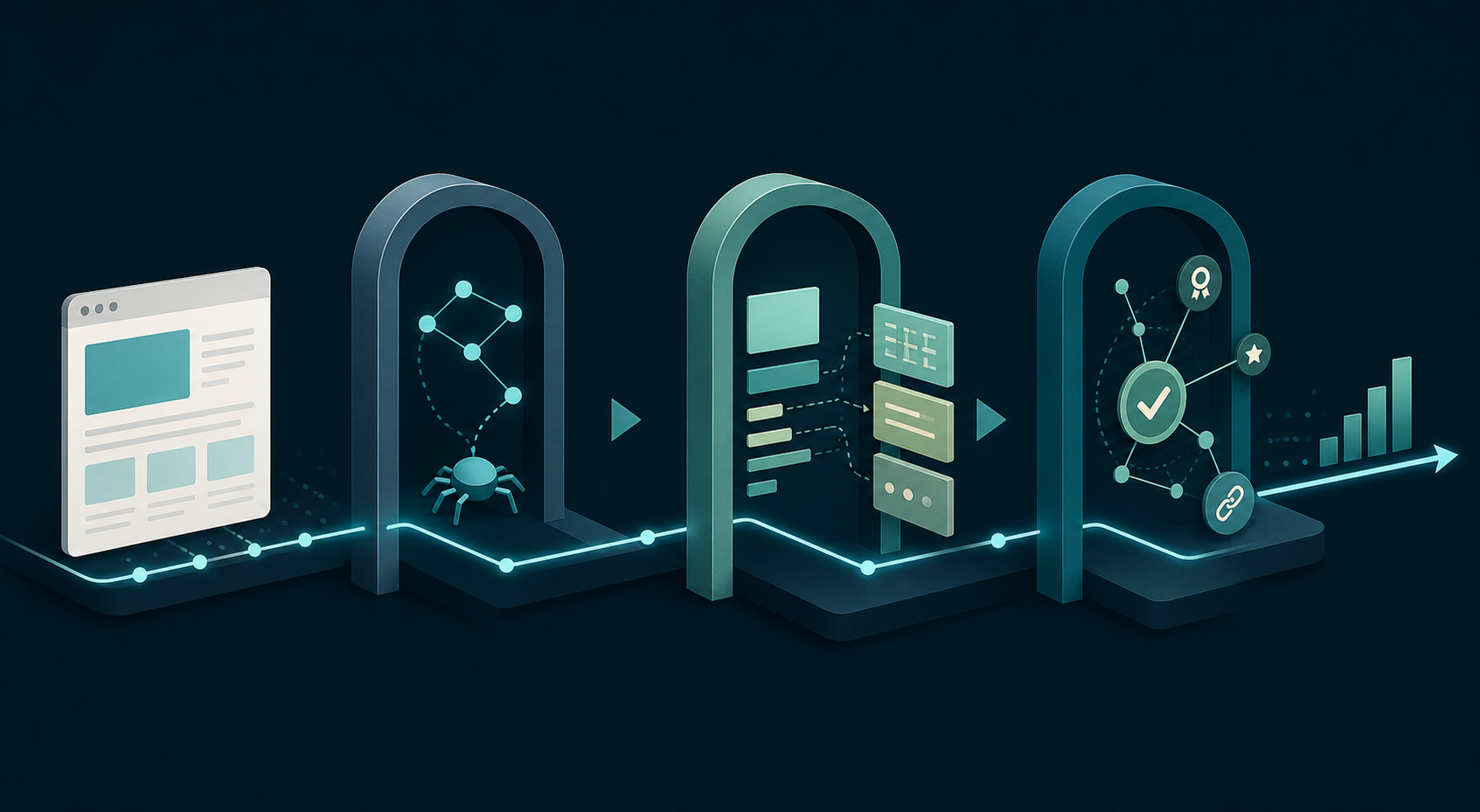
The issue is usually upstream. Three gates stand between your brand and a ChatGPT citation: access, understanding, and authority. Close any one of them and content work stops mattering. This guide explains what each gate means, how to identify which one is blocking you, and what to fix first.
Key Takeaways
- → ChatGPT fires a live search at query time. Google rankings feed the retrieval pool, but ranking on Google does not guarantee a citation.
- → The top 20% of a page generates 3–4x more citations than the bottom 10%. Your most citable answer belongs at the top, not the middle.
- → Over 65% of AI citations come from third-party sources. Earned mentions outperform self-published content for authority.
- → Most ChatGPT visibility failures trace to one gate: access, understanding, or authority. Diagnose before you fix.
- → Fix access first (Bing indexing, robots.txt, IndexNow), understanding second (content structure, schema), authority third (digital PR, reviews, community).
What ChatGPT optimization actually means
ChatGPT optimization means structuring your content and brand presence so ChatGPT retrieves, extracts, and cites your pages when answering relevant queries. Not using ChatGPT as a writing tool. Being cited by it.
The optimization target is different from Google SEO. Google SEO moves a page from position 12 to position 3. ChatGPT optimization makes your page the source a language model pulls from when a user asks something in your category.
One mechanic shapes everything: ChatGPT does not answer most queries from training data . It fires a live search at query time, retrieves a candidate set of pages, and selects which ones to cite. Google rankings matter because they feed that retrieval pool. But ranking on Google is necessary, not sufficient. A page at position 11 can be one of ChatGPT's most-cited assets in your category, while a position-1 page gets zero AI mentions, if the position-1 page fails extraction or authority.
For a detailed playbook of tactics once your foundation is solid, see the guide to optimizing for ChatGPT search . This article covers the diagnostic layer first.
Why most ChatGPT optimization advice fails
Most guides lead with tactics: add schema, update your content, build more backlinks. None of that is wrong. The problem is sequencing. Tactics applied to a blocked pipeline produce nothing, and teams spend months rewriting content while the actual blocker is one robots.txt entry or a missing Bing indexing step.
Research across content verticals found a Ski Ramp citation pattern: the top 20% of a page generates three to four times more citations than the bottom 10%. The implication is not "publish more." It is "put your most citable claim in the first section." Teams that restructure existing pages for front-loaded answers outperform teams that publish new articles without fixing structure.
What's more surprising: Google rank and AI citation rank are largely independent. One practitioner found their position-11 article was one of their best-performing assets for Perplexity citations — a page that wouldn't appear in a standard ranking report at all. Brands that only track Google Search Console are measuring half the picture.
The correct starting point is a diagnosis: which gate is the bottleneck?
The three failure types: access, understanding, authority
Every ChatGPT citation failure traces to one of three root causes. Access failures prevent the page from entering the retrieval pool. Understanding failures prevent ChatGPT from extracting clean answers even when the page is retrieved. Authority failures cause ChatGPT to deprioritize the brand even when content is accessible and well-structured.
| Gate | What it controls | Fastest diagnostic |
|---|---|---|
| Access | Whether ChatGPT can crawl and index your pages | Check robots.txt for GPTBot/PerplexityBot; search site:yourdomain.com on Bing |
| Understanding | Whether ChatGPT can extract clean answers from your pages | Check if the first 200 words of each page contain a direct answer |
| Authority | Whether ChatGPT trusts your brand as a credible source | Search your brand on Reddit, G2, and industry publications |
Access: can ChatGPT's crawlers reach your content?
Access is the first gate. If ChatGPT's crawlers cannot reach your pages, nothing downstream changes the outcome.
ChatGPT uses Bing's index as its primary retrieval layer for real-time answers. Most sites are indexed on Google but have never submitted a sitemap to Bing Webmaster Tools. That one gap makes the site invisible to ChatGPT's live search regardless of content quality.
A second access blocker lives in robots.txt. Brands that accidentally block GPTBot or PerplexityBot — often from a broad bot-blocking pass done years ago — eliminate AI crawler access entirely. The site keeps ranking on Google. AI search systems cannot reach it.
IndexNow is the third access lever. Submitting URLs to Bing via IndexNow gets new and updated content into Bing's index faster, which directly improves how quickly ChatGPT can retrieve those pages.
Access checks take under 30 minutes. They resolve a disproportionate share of ChatGPT visibility gaps, especially for service businesses that have never touched Bing.
Understanding: can ChatGPT extract clean answers from your content?
Once a page is retrievable, it has to survive extraction. ChatGPT selects pages with clean, self-contained passages it can use directly in a response. Pages that bury key claims mid-paragraph, open with several screens of setup, or lack clear heading structure get passed over for easier sources.
The Ski Ramp rule: put the most citable answer in the first 20% of the page. For most brand pages that means rewriting the intro and the first sentence of each H2 to open with a direct, factual answer rather than framing text. The content can still develop from there — but the extractable claim needs to come first.
Schema markup is the second understanding lever. FAQPage and HowTo schema package answers into formats AI systems can parse directly. A page with FAQPage schema that matches visible Q&A content tells ChatGPT the page's format and answer structure explicitly.
See our guides on generative engine optimization and answer engine optimization for the broader content structure context.
Authority: does ChatGPT trust your brand as a credible source?
Authority is the hardest gate to move and the most commonly misread. Most brands respond to low AI visibility by publishing more. That does not build AI authority.
Over 65% of citations in AI responses come from third-party sources : Reddit threads, industry publications, review aggregators, LinkedIn, YouTube. AI models are trained on and cite content from contexts they didn't create. Authority in AI search is built off-site, not on it.
The test is entity authority: how often does the brand appear in authoritative sources outside its own domain? A brand with 100 blog posts and no third-party coverage will lose to one with 10 posts and strong Reddit presence, genuine review platform coverage, and editorial placements.
Building authority means getting mentioned in contexts you don't control: digital PR, customer reviews on G2 or Trustpilot, Reddit engagement on category topics, analyst coverage. Slower than publishing articles, but it is the actual lever for the authority gate.
How to diagnose your ChatGPT optimization gap
A five-step audit identifies which gate is failing without a tool subscription.
- 1 Check robots.txt. Open yourdomain.com/robots.txt. Look for GPTBot and PerplexityBot. If either is disallowed, that is your first fix.
- 2 Verify Bing indexing. Search
site:yourdomain.comin Bing. If core pages are missing, submit your sitemap to Bing Webmaster Tools and configure IndexNow. - 3 Run manual citation checks. Open ChatGPT and Perplexity. Search your primary keywords and brand name. Note whether you appear and which competitors do. This tells you if the gap is broad or query-specific.
- 4 Audit your top five pages for front-loaded answers. Does the first 200 words of each page contain a direct, factual answer to what the page targets? If the opening is framing or context rather than an answer, restructuring it is the highest-leverage content change.
- 5 Check third-party brand presence. Search your brand on Reddit, G2, and a relevant industry publication. If you don't appear in topically relevant discussions, the authority gate is the bottleneck regardless of on-site content quality.
Most teams find one or two clear blockers. Fix order follows the gates: access, understanding, authority.
The fix priority order: infrastructure before content
The sequence is determined by gate dependency. Access failures nullify everything downstream. No point restructuring headings if GPTBot can't crawl the page.
- → Fix access first. Correct robots.txt blocks. Submit to Bing Webmaster Tools. Set up IndexNow. Add an llms.txt file for fine-grained AI crawler control. Most of this takes one afternoon.
- → Fix understanding second. Restructure the opening of each priority page so the most citable claim is in the first 200 words. Add or correct FAQPage and HowTo schema. Confirm heading structure uses real H2/H3 tags.
- → Fix authority third. Start a digital PR effort targeting editorial placements in your category. Build profiles on relevant review platforms. Engage on Reddit where your audience discusses the problems you solve.
Run a Shopify store? See what SEO + GEO looks like, done for you.
One flat price covers a monthly audit, on-page fixes, and new articles written for Google and AI answer engines.
How to measure ChatGPT optimization progress
No native ChatGPT search console exists. The practical proxy for AI search optimization progress is Share of Model.
Define a fixed query set — 10 to 20 queries relevant to your category — and run them on ChatGPT, Perplexity, and Google AI Overviews monthly. Log whether your brand is cited, mentioned without citation, or absent. Track the score over time and connect shifts to specific changes.
For platform-level tracking, Semrush's AI Visibility Report , Peek AI, and EarlySEO each provide citation share dashboards. These scale better than manual queries once you're tracking dozens of pages.
A useful starting check: pull your top 20 URLs from Google Search Console by impressions. For each one, run a manual ChatGPT query. Log which pages are cited and which are not. The gap between GSC performance and AI citation performance tells you where to focus first.
See the Shopify AI visibility tracking guide for what a citation baseline report looks like in practice.
Frequently asked questions
What is ChatGPT optimization?
ChatGPT optimization is structuring your content and brand presence so ChatGPT retrieves, extracts, and cites your pages in its answers. It covers technical access (Bing indexing, robots.txt), content structure (front-loaded answers, schema), and third-party authority (editorial coverage, reviews, community presence).
How is ChatGPT optimization different from SEO?
SEO targets a ranking position in Google. ChatGPT optimization targets an in-response citation from a language model. Google rewards a page for ranking; ChatGPT rewards a passage for being extractable and credible. The two overlap — Google rankings feed the retrieval pool ChatGPT draws from — but they are different problems requiring separate measurement.
Why is my brand not showing up in ChatGPT even though I rank on Google?
Google rank and AI citation rank are independent. Your brand may be blocked at the access gate (Bing not indexed, crawlers blocked), the understanding gate (content not structured for extraction), or the authority gate (insufficient third-party mentions). Ranking on Google is the starting point, not the finish line. Diagnosing which gate is closed is the first step.
Does publishing more content help with ChatGPT optimization?
Not if an upstream gate is blocked. More content does not fix Bing indexing, unblock crawlers, or build third-party authority. Publishing helps when access and structure are clear and authority is the bottleneck — but even then, off-site editorial and review coverage builds AI authority faster than on-site articles.
How long does ChatGPT optimization take to work?
Access fixes can change AI visibility within days to weeks once pages are crawled and indexed. Content restructuring follows normal crawl cycles — typically two to eight weeks. Authority improvements through PR and reviews compound over months. The fastest results come from access fixes on sites that were blocked entirely.
What is Share of Model?
Share of Model is a measurement method for AI citation visibility. You define a fixed query set for your category and run those queries on ChatGPT, Perplexity, and other AI surfaces regularly. You track citation, mention without citation, or absence, and score the results over time.
ChatGPT optimization fails when it skips the diagnostic step. Most teams invisible in AI answers have a blocked access gate or a structure problem — not a content volume problem. Find which gate is closed, fix it in order, and measure the change. That is the full process.
Use the AI Visibility Audit to map all three gates against your site in one session — so you stop guessing which fix to make next.