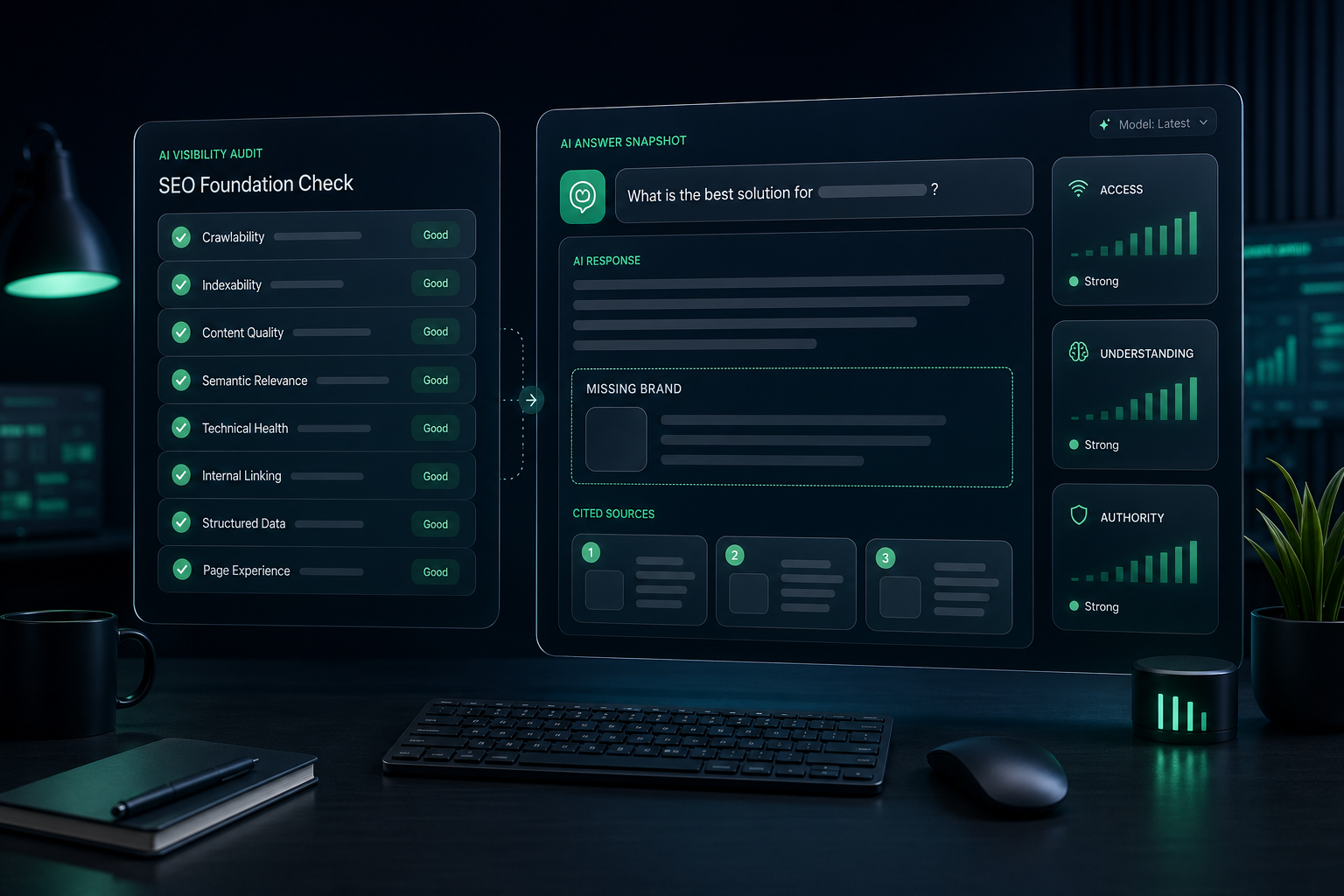
A clean SEO audit can be accurate and still leave the real problem untouched.
Your pages may be crawlable. Your metadata may be cleaned up. Your internal links may make sense. You may even rank on page one for the keywords that matter.
And ChatGPT may still ignore your brand.
That does not always mean your SEO audit was bad. It usually means it answered a different question. A traditional SEO audit asks whether search engines can crawl, index, and rank the site. An AI visibility audit asks whether AI systems can access, understand, and trust the brand enough to mention it in an answer.
Short answer
If your SEO audit says everything is fine but you are missing from ChatGPT, the issue is usually access, understanding, or authority. The normal SEO checklist can look clean while the AI visibility checklist still has serious gaps.
What your SEO audit probably checked
A traditional SEO audit is still useful. This is not an "SEO is dead" argument. AI visibility still depends on accessible pages, clear content, structured information, and search indexes.
A normal audit probably checked things like:
- -whether Google can crawl your site
- -whether important pages are indexed
- -whether titles, descriptions, headings, and canonicals are sane
- -whether pages are thin, duplicated, outdated, or competing with each other
- -whether internal links support important pages
Those checks matter. If they fail, fix them. But passing them does not prove that ChatGPT knows when to recommend you. It only proves that your traditional search foundation is not obviously broken.
The practical point is this: SEO is infrastructure, but AI citation needs its own measurement. Without the SEO foundation, AI visibility work turns into theater. Without AI-specific testing, a clean SEO report can still miss the gap.
What it probably did not check
Most SEO audits are not built around AI answer visibility.
They often do not test whether your brand appears in ChatGPT or Perplexity for buyer prompts. They do not record which competitors appear instead. They do not map which third-party sources are being cited. They do not check whether Bing has the right pages, whether AI-specific crawlers are blocked, or whether your service pages are written in a way that an answer engine can extract.
A normal SEO audit may say, "This page is optimized for the keyword." An AI visibility diagnostic asks, "Would an AI answer choose this company as a credible recommendation for the prompt? If not, why not?"
Want a Shopify-specific starting point?
Use the Shopify AI visibility checklist to check crawler access, product data, and off-site trust signals before deciding what to fix.
The three places AI visibility usually breaks
At Uygen, we split the problem into three buckets: access, understanding, and authority. This keeps the diagnosis practical. It also prevents the lazy answer that every AI visibility problem is just "write better content."
1. Access
Access is the first check because it can block everything else. If AI systems, AI search partners, or relevant crawlers cannot reach the right pages, your content quality does not matter yet.
The issue may be robots.txt, AI crawler rules, Bing indexation, sitemap freshness, JavaScript rendering, bot protection, redirects, or pages that are technically live but hard for machines to fetch cleanly.
2. Understanding
AI systems need to know what your company is, who it is for, what problem it solves, when to recommend it, and what proof supports that recommendation. Many websites make this harder than they realize.
A human can sometimes infer what you mean. An AI answer system may skip you because a competitor is easier to summarize. The competitor may not be better. They may simply be clearer.
3. Authority
Your own website can say you are the best fit. That does not mean AI systems will cite you. They often look for outside confirmation: reviews, comparison pages, industry mentions, community discussions, partner pages, directories, documentation, and other sources that help define the category.
The authority question is not, "Do we have backlinks?" It is, "When AI systems answer buyer prompts in our category, which sources do they trust, and are we present in those sources?"
How this shows up in a real diagnostic
A useful AI visibility diagnostic should not stop at "you are missing from ChatGPT." That is only the symptom.
You should expect to see:
- -which prompts were tested
- -whether your brand appeared
- -which competitors appeared instead
- -which sources were cited
- -whether important pages were accessible and extractable
- -the top three fixes, in order
That last part matters. A weak audit gives you a long list. A useful audit tells you what to fix first.
When you need another SEO audit vs an AI visibility audit
You may need another SEO audit if your site has obvious search fundamentals issues: pages are not indexed, migrations went wrong, key pages are thin, technical errors are widespread, or organic traffic dropped because rankings actually declined.
You probably need an AI visibility audit if the fundamentals look stable but the AI answer layer does not match that picture.
| Signal | Better next step |
|---|---|
| Pages are not indexed or migration issues are unresolved | Traditional SEO audit |
| You rank in Google but are absent from ChatGPT prompts | AI visibility audit |
| Competitors appear in AI answers even when you outrank them | AI visibility audit |
| Your current report has no prompt or citation-source testing | AI visibility audit |
It is not a guarantee that ChatGPT will mention you next week. We are explicit about that in our guide to what an AI visibility audit cannot guarantee . The value is finding the blockers and the order of operations. For a fuller component breakdown, see what an AI visibility audit includes .
What to do next
Do not buy another vague optimization package because a dashboard says your AI visibility is low. First, ask what was actually tested.
Did anyone check access? Did anyone test real prompts? Did anyone compare cited sources? Did anyone review whether your pages are extractable? Did anyone separate technical blockers from authority gaps?
If not, your SEO audit may be fine. It just was not the audit for this problem.
FAQ
Can a clean SEO audit still miss AI visibility problems?
Yes. A clean SEO audit can confirm that your site is technically healthy for traditional search while still missing prompt visibility, AI crawler access, Bing coverage, entity clarity, or off-site citation gaps.
Why would ChatGPT ignore a site that ranks in Google?
Because Google ranking and AI citation are related but not identical. ChatGPT may rely on different discovery paths, cited sources, answer structures, and authority signals.
What should I check first if my brand is missing from ChatGPT?
Start with access: robots.txt, AI crawler rules, Bing indexing, sitemap freshness, important page availability, and whether bot protection or rendering issues block clean retrieval.
Is an AI visibility audit a replacement for an SEO audit?
No. It is a different diagnostic. SEO audits are still useful for search fundamentals. AI visibility audits focus on whether AI systems can access, understand, and cite your brand in answers.
See what Uygen checks and fixes
Start with the Shopify checklist. If you want the audit, fixes, and weekly content handled for you, book a call.