Most teams with an established content library already know something is wrong. Older posts are decaying, some pages compete with each other, and others remain indexed despite serving no meaningful demand. An SEO content audit turns that vague discomfort into a ranked action queue.
The problem is that many audits stop at a spreadsheet. Teams export URLs, traffic, and rankings, then stall because there is no rule for what to do next. A useful audit is not a report. It is a decision system.
This framework covers the five layers we think matter now: traditional SEO signals, GEO citation-readiness , AEO structure , local alignment, and structural health. The goal is simple: every page ends with a clear next action.
Key Takeaways
- → A content audit should evaluate performance, intent, structure, citation-readiness, and business value, not just traffic.
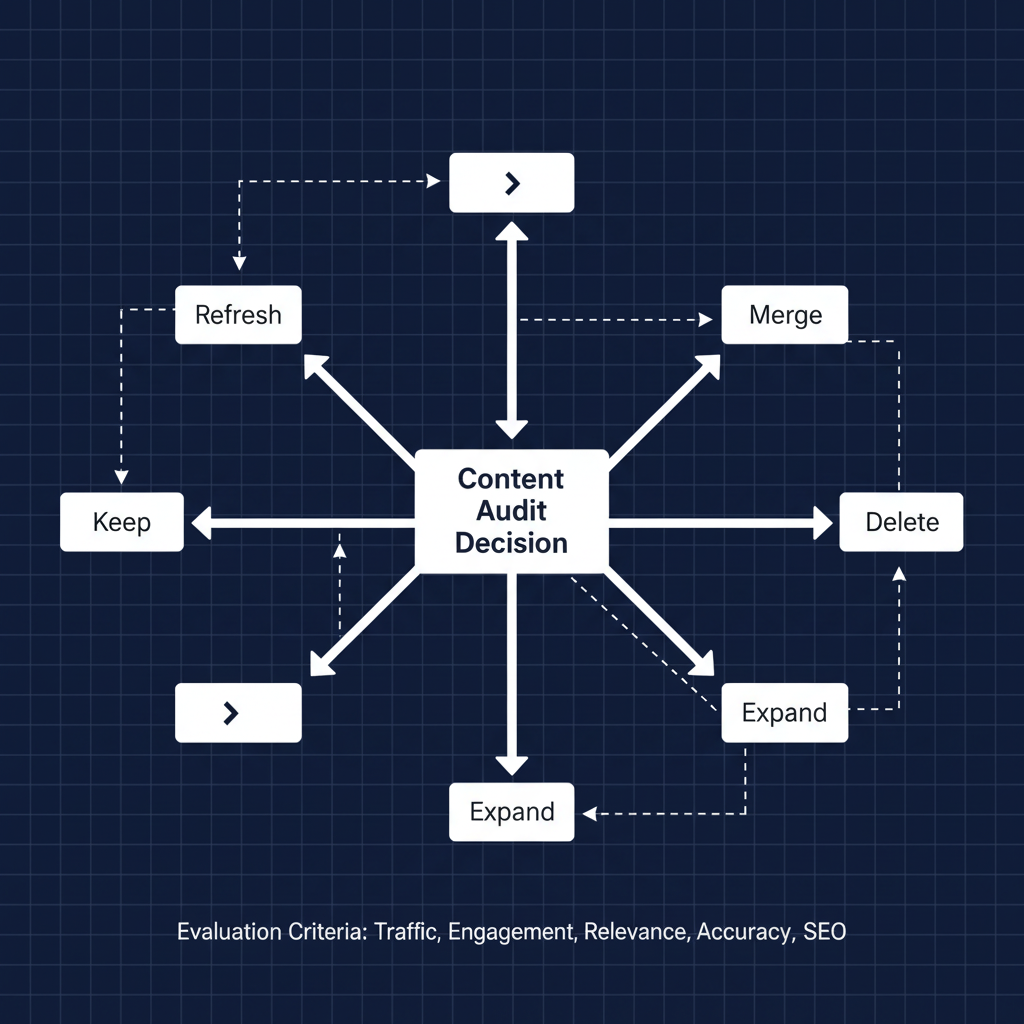
- → The five decisions are Keep, Refresh, Merge, Expand, or Delete + Redirect.
- → Near-win pages ranking positions 4 to 20 are usually the highest-ROI first targets.
- → GEO and AEO checks belong inside the audit now because ranking alone no longer captures how content is discovered.
- → A quarterly rolling audit usually produces more action than a large annual sweep.
What an SEO content audit actually is
An SEO content audit is a systematic evaluation of every indexed content page against performance, quality, and intent criteria. The output is not a content inventory. It is a set of decisions about what each page should do next.
That distinction matters. An inventory tells you what exists. An audit tells you whether a page is earning its place, why it is underperforming, and whether the best next move is to keep it, improve it, consolidate it, or remove it.
Looking only at rankings is no longer enough. A page can rank and still fail because it answers the wrong intent, lacks direct passages that AI systems can cite, or sits outside the site architecture with no meaningful internal links.
Why most audits fail to produce action
Most audits fail for one reason: they stop before a decision rule exists. Teams crawl the site, export metrics, and produce a spreadsheet that nobody knows how to execute.
- → Scope is too narrow. Traffic and position data miss AI citation-readiness, schema gaps, and structural issues.
- → There is no action model. Without thresholds for refresh versus merge versus delete, every URL becomes a debate.
- → There is no prioritization layer. A flat list of 200 refreshes is backlog theater, not a plan.
- → The cadence is too slow. A rolling quarterly cycle creates smaller, more executable batches than an annual sweep.
The five layers a complete audit should cover
A strong audit evaluates each page through five layers. Skipping any one of them creates a blind spot.
1. Traditional SEO signals
Use Google Search Console and GA4 at the URL level. Look for near-win pages, content decay, cannibalization, weak CTR, and URLs with impressions but no conversion value.
2. GEO citation-readiness
GEO asks whether a page can be cited in AI-generated answers. That usually means a direct answer near the top, clear subquestion structure, source-backed claims, and crawl access for AI systems. If your team needs the underlying context first, start with our GEO guide and the more tactical ChatGPT search checklist .
3. AEO and structured answers
AEO focuses on snippet eligibility, question-answer structure, and schema. Pages with FAQ sections should validate `FAQPage` markup. Process content should be checked for `HowTo` opportunities. If you want the model-level view, read the AEO guide .
4. Local and market alignment
For multi-location or multi-market sites, audit hreflang, local intent alignment, and whether national pages are trying to serve queries that really need regional variants.
5. Structural health
Check internal link coverage, crawl issues, duplicate content, and Core Web Vitals. Content that is technically weak or buried in the site graph cannot carry its own weight.
The five decisions: what to do with each page
Every audited page should land in one of five buckets.
- → Keep: the page is doing its job and needs only a future review.
- → Refresh: the intent is right, but the page needs updates, stronger structure, fresher data, or better schema.
- → Merge: two pages overlap and should become one stronger URL.
- → Expand: the topic is worth keeping, but the current page is too thin to compete or get cited.
- → Delete + Redirect: the page has no business value, no recovery path, and should transfer any residual equity to a better destination.
| Signal | Typical Decision |
|---|---|
| Ranks 1-10, stable traffic, no structural issues | Keep |
| Ranks 4-20 with impressions and intent match | Refresh |
| Thin content on a valuable topic with some traction | Expand |
| Overlaps with a stronger page in the same query set | Merge |
| No traffic, no links, no business value | Delete + Redirect |
| Ranks, but fails GEO or AEO structure checks | Refresh with structural rewrite |
After that, stack-rank the non-keep pages by impact versus effort. That is what turns the audit into a production queue instead of a findings document.
How to run the audit in order
- 1. Build the inventory. Crawl the site and remove non-content URLs so you have a clean working universe.
- 2. Pull URL-level performance data. Join GSC and GA4 data across impressions, clicks, positions, sessions, and conversions.
- 3. Score each page against the five layers. Keep the scoring simple enough that multiple people can apply it consistently.
- 4. Assign one of the five decisions. Document the specific reason for every page that is not a Keep.
- 5. Prioritize by impact versus effort. Near-win refreshes and schema fixes on already-ranking pages usually rise to the top.
- 6. Write execution briefs. A refresh or expand decision should become a concrete production brief that can ship without another meeting.
If you want the audit output to become actual work, the next step after Decide is execution. That usually means moving from Audit into Produce.
The gaps most audits miss
- → Internal link orphans. Pages with zero or one inbound internal link are effectively disconnected from the site graph.
- → Schema gaps on pages that already rank. These are often low-effort wins.
- → Citation-readiness failures. Pages written as essays rather than direct-answer structures can rank but still fail in AI surfaces.
- → Non-obvious cannibalization. Different keywords can still overlap if Google treats the pages as serving the same query set.
- → Market alignment issues. International and local pages often fail for structural reasons rather than content quality alone.
From audit findings to an execution loop
An audit is not the end of the work. It is the Decide phase of a recurring operating loop. Once the decisions exist, the team needs to produce the fixes, validate them, publish them, and measure what changed.
That is why audits and production should feel connected. On Uygen, the clean path is to start with Audit, then move the highest-priority items into Produce. The point is not to generate another spreadsheet. It is to create a backlog that actually ships.
Need the framework applied to your own site?
Start AuditingFrequently asked questions
What is a content audit and why is it important for SEO?
A content audit is a systematic evaluation of every indexed page to assess performance, quality, and intent alignment. It matters because it shows which pages are decaying, cannibalizing each other, or failing to match search intent, so your team fixes the right pages first.
What is the difference between a content audit and a content inventory?
A content inventory lists what exists: URLs, dates, word counts, and baseline metrics. A content audit evaluates those pages against clear criteria and assigns a next action such as keep, refresh, merge, expand, or delete.
How do you prioritize which pages to fix first?
Start with near-win pages ranking between positions 4 and 20 that already have impressions. Then move to schema gaps, high-value merge candidates, and pages that rank but fail GEO or AEO structure checks. Impact versus effort is the simplest prioritization model.
What should you do with underperforming content: update, merge, or delete?
Refresh when the page has the right intent but weak execution. Merge when two pages overlap and compete for the same query set. Delete and 301 redirect when a page has no traffic, no links, and no business value.
How often should you run an SEO content audit?
A quarterly rolling audit is usually stronger than a single annual sweep. It catches content decay earlier, creates smaller execution batches, and keeps the backlog aligned with what has changed in search.
How do GEO and AEO fit into an SEO content audit?
They add two layers most traditional audits miss. GEO checks whether content is citation-ready for AI-generated answers, while AEO checks question-answer structure, snippet eligibility, and structured data such as FAQPage or HowTo.
An SEO content audit is one of the highest-leverage things a team with existing content can do. It shows what is decaying, what is overlapping, and what is invisible to newer search surfaces.
The important part is not the audit itself. It is the clarity that follows: what to keep, what to fix first, and how to turn that decision into shipped work.