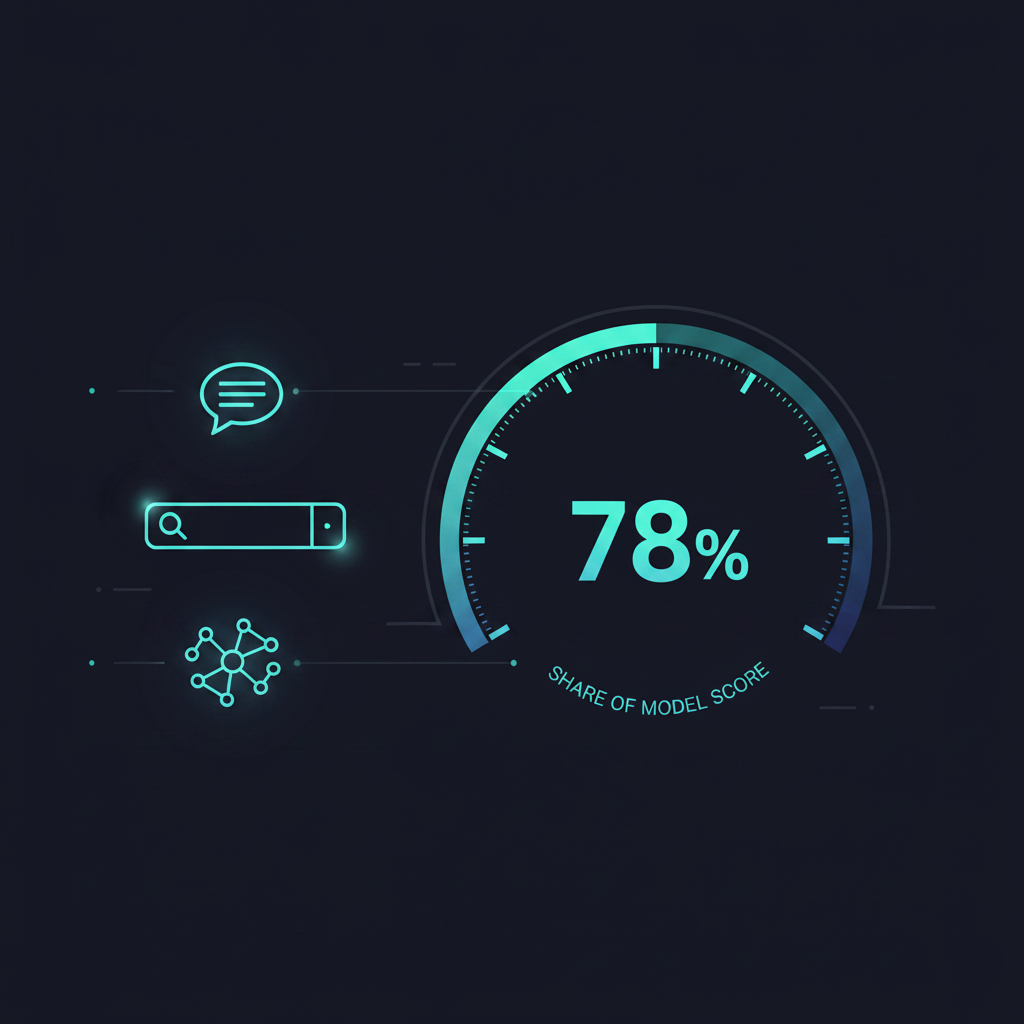
A brand can rank on page one of Google and still be completely absent from ChatGPT, Perplexity, and Gemini answers. That gap used to be invisible. Share of Model is the metric that makes it measurable.
Share of Model tracks how often your brand is mentioned or cited when a defined set of relevant prompts is tested across AI platforms. It works like Share of Voice in traditional media — except instead of measuring search ranking presence, it measures AI citation presence.
This guide explains what Share of Model is, how to calculate it, how to track it week to week, and what to do when your number is low.
Key Takeaways
- Share of Model (SoM) = (Prompts where your brand appears ÷ Total prompts tested) × 100.
- A brand can rank on page one in Google and have near-zero Share of Model — the two systems are largely decoupled.
- AI answers are non-deterministic: the same prompt can return different results in different sessions. Track trends over 4–6 weeks, not one-off snapshots.
- Perplexity cites sources with links; ChatGPT usually mentions brands without linking. Track both signals separately.
- A low SoM is a symptom. The root cause is usually access, understanding, or authority — not content volume.
- The right next step after measuring SoM is diagnosing which gate is blocking you.
What is Share of Model?
Share of Model (SoM) is the percentage of AI-generated responses in which your brand appears when a fixed set of relevant prompts is tested across generative AI platforms.
The formula:
Share of Model = (Prompts where your brand appears ÷ Total prompts tested) × 100
If you test 40 prompts across ChatGPT and Perplexity and your brand appears in 8 responses, your Share of Model is 20%.
SoM captures two related signals:
- Mention presence: Your brand name appears in the AI's answer text.
- Citation presence: Your website URL is cited as a source (most relevant on Perplexity, which links sources on nearly every answer).
Both matter, but differently. A brand mentioned without citation is in the conversation. A brand cited with a link is being used as evidence. Tracking them separately gives a cleaner picture. The URL-attributed subset — citation share — is now measurable for free in Bing Webmaster Tools AI Performance.
Practitioners running this metric regularly report a citation rate of 10–25% as a reasonable range for brands actively working on AI visibility, though the benchmarks are still settling.
Share of Model vs Share of Voice: what changed
Share of Voice measures how often your brand appears in search results relative to competitors. Share of Search measures what fraction of total search volume includes your brand name. Both assume a search results page where brands compete for ranked positions.
That model is breaking down.
A meaningful share of buyer journeys now starts inside an AI assistant. The person asking ChatGPT which AI visibility audit provider to use never sees a search results page. If your brand is not in the AI's answer, you are not in the consideration set — regardless of where you rank in Google.
| Metric | What it measures | What it misses |
|---|---|---|
| Share of Voice | Search ranking presence | AI answer presence |
| Share of Search | Query volume with your brand name | Citation in zero-click environments |
| Share of Model | AI citation frequency across platforms | Why the number is low |
Share of Model does not replace Share of Voice. Organic search still drives significant traffic. But SoM covers the part of the buyer journey that traditional metrics cannot see — and for many B2B brands, that gap is already large.
Which platforms to track
Citation behavior varies across platforms. A combined score obscures platform-specific gaps, so track each one separately.
| Platform | Citation behavior | What to track |
|---|---|---|
| ChatGPT | Mentions brands in answer text; rarely links to sources in standard responses | Mention presence |
| Perplexity | Cites sources with links on nearly every answer | Mention presence and citation link |
| Gemini | Varies by query type; links in some responses | Mention presence; note when links appear |
| Google AI Overviews | Tied to Google's organic index; shows above standard results | Citation links to your site or third-party sources |
Perplexity and ChatGPT both depend on Bing's index for real-time answers, which means Bing indexing is a shared access gate. A page not indexed in Bing is less likely to appear as a live source in either. Bing Webmaster Tools now includes GEO reporting and is a free native layer worth checking alongside any manual tracking you do.
Start with ChatGPT and Perplexity. For a detailed breakdown of how Perplexity sources answers and what you can do to improve citation eligibility, see the guide on how to optimize for Perplexity Search. Add Gemini and Google AI Overviews once you have a working baseline.
How to measure Share of Model
Measurement starts with a fixed prompt set — not a one-off search.
Manual tracking (free)
Step 1 — Build your prompt set
Define 10–20 prompts across four query types:
- Category discovery: "best AI visibility audit providers" or "companies that help brands appear in AI answers"
- Problem diagnosis: "why is my brand not cited in ChatGPT" or "how do I check if AI tools mention my company"
- Comparison: "[your brand] vs [competitor] for AI visibility"
- Implementation: "how to improve brand mentions in Perplexity"
Use the same prompts every week. Changing them mid-stream makes trend tracking meaningless.
Step 2 — Run each prompt on each platform (manual tracking guide)
Pick one day per week and run each prompt in a fresh session on ChatGPT, Perplexity, and Gemini. For each response, log:
- Brand mentioned: yes / no
- Brand URL cited: yes / no
- Which competitors appeared
- Whether the answer described your offer accurately
Step 3 — Calculate and trend
(Brand appearances ÷ Total prompts tested) × 100 = SoM for that platform. Log it weekly. Four to six weeks of data is the minimum before trends are meaningful.
Tool-based tracking
| Tool | Platforms covered | Best for |
|---|---|---|
| Profound | ChatGPT, Perplexity, Gemini, AI Overviews | Most comprehensive multi-engine coverage |
| AthenaHQ | Strong ChatGPT focus | Teams prioritizing ChatGPT data |
| Otterly | Multi-engine, lower cost | Budget-constrained teams |
| Rankscale | Multi-engine | Agencies managing multiple clients |
For most teams, a manual spreadsheet is the right starting point. Move to a paid tool when prompt volume or client reporting requirements make manual tracking impractical.
The measurement problem: AI answers are not deterministic
The same prompt can return a different answer in a different session, on a different day, or with different prior context in the conversation. A single measurement is not a reliable SoM reading.
Three things follow:
- Repeated sampling is required. A one-week snapshot tells you almost nothing. A six-week rolling average tells you something real.
- SoM moves slowly. A single-week dip is not a signal. Citation behavior usually takes weeks to shift after you make changes.
- Run in fresh sessions. Prior conversation context influences responses. Start each weekly run in a clean session.
This is the key difference from rank tracking. SoM requires statistical patience — track the trend, not the snapshot. For why the same prompt can return a different brand list almost every time, see why AI recommends some brands and not others: a model's answer often draws on a pre-formed recall of a category as much as, or more than, whatever it retrieves live.
What a low Share of Model actually means
A low Share of Model is a symptom. It tells you your brand is not appearing in AI answers at the rate it should. It does not tell you why.
Research on AI citation patterns suggests that LLM ranking is driven more by off-site presence than by on-page quality. The top 15 domains capture roughly 68% of all consolidated AI citation share — far more concentrated than traditional search. Reddit alone appears in approximately 40% of AI citations across major platforms.
So a low SoM often reflects an external citation footprint problem more than a content problem. But not always.
Three gates determine AI citation eligibility:
- Access: Can AI systems reach the pages you want cited? Blocked crawlers, unindexed pages, Bing indexing gaps, and rendering failures all cut off evidence before the AI can use it.
- Understanding: When an AI system reaches your page, can it extract a clear, specific answer about your brand, category, and claims? Vague copy and inconsistent brand language lower extractability.
- Authority: Does the wider web corroborate your brand's claims? Third-party reviews, directory listings, media mentions, Reddit discussions, and partner pages feed the citation ecosystem that AI systems draw from.
A brand with a 5% Share of Model might have an access problem, an understanding problem, an authority problem, or all three. The number alone does not show which. Diagnosing the right gate is the step that should come before any action.
For more on the access/understanding/authority framework, see the Shopify AI visibility checklist.
When to start with an AI Visibility Audit
If you have measured your Share of Model and it is lower than expected, the question becomes: which gate is blocking you?
You can work through this yourself — checking access, then understanding, then authority. That takes time and requires knowing what to look for at each step.
An AI Visibility Audit compresses that process. It covers:
- Bot access verification across priority pages, including Perplexity and Bing crawl paths
- Page extractability review against your actual prompt query set
- Competitor citation gap analysis — which domains and third-party sources appear instead of yours
- Live prompt testing across ChatGPT, Perplexity, Gemini, and Google AI
- Source ecosystem mapping of where your brand is and is not represented
- A 90-day fix roadmap with priorities ordered by impact and effort
The output is not another metric — it is a specific fix list in priority order. If you already know which gate is the problem, you may not need one. If your SoM is low and the cause is unclear, an audit is the lower-risk path compared to guessing.
See the Shopify AI visibility checklist for how the audit works, or review a Shopify AI visibility tracking guide to see what the output looks like.
FAQ
What is Share of Model?
Share of Model (SoM) is the percentage of AI-generated responses in which your brand appears when a fixed set of relevant prompts is tested across generative AI platforms. Formula: (Prompts where your brand appears ÷ Total prompts tested) × 100.
How do you calculate Share of Model?
Build a fixed set of 10–20 relevant prompts, run them across your target AI platforms in fresh sessions, log whether your brand appears in each response, then divide appearances by total prompts and multiply by 100. Track the same prompt set weekly to identify trends.
What is the difference between Share of Model and Share of Voice?
Share of Voice measures how often your brand appears in search results relative to competitors. Share of Model measures how often your brand appears in AI-generated answers. A brand can have strong Share of Voice in Google and near-zero Share of Model in ChatGPT and Perplexity — they are measuring different discovery environments.
How do you track AI citations without a paid tool?
Define a fixed set of 10–20 prompts covering category discovery, problem diagnosis, comparison, and implementation queries. Run each in a fresh session on ChatGPT, Perplexity, and Gemini once a week. Log mention presence, citation link presence, and competitor appearances in a spreadsheet. Calculate SoM as (appearances ÷ prompts tested) × 100. Allow 4–6 weeks before drawing conclusions.
What does it mean if my Share of Model is low?
A low Share of Model means your brand is not appearing in AI answers at the rate it should, but it does not tell you why. The three possible root causes are access (AI systems cannot reach your evidence), understanding (AI cannot extract a clear answer from your pages), and authority (third-party sources do not support your brand's claims). Identify which gate is the problem before acting.
Which AI platforms should I track for Share of Model?
Start with ChatGPT and Perplexity — they have the highest business query volume and the most distinct citation behaviors. Add Gemini and Google AI Overviews once you have a baseline. Track each platform separately; a combined score hides platform-specific gaps.
Share of Model is not a vanity metric. It is the measurement layer that makes AI citation visibility legible — and the starting point for understanding why your brand is missing from answers that your competitors are already appearing in.
Measure the number. Then diagnose the gate.
Run a Shopify store? See what SEO + GEO looks like, done for you.
One flat price covers a monthly audit, on-page fixes, and new articles written for Google and AI answer engines.