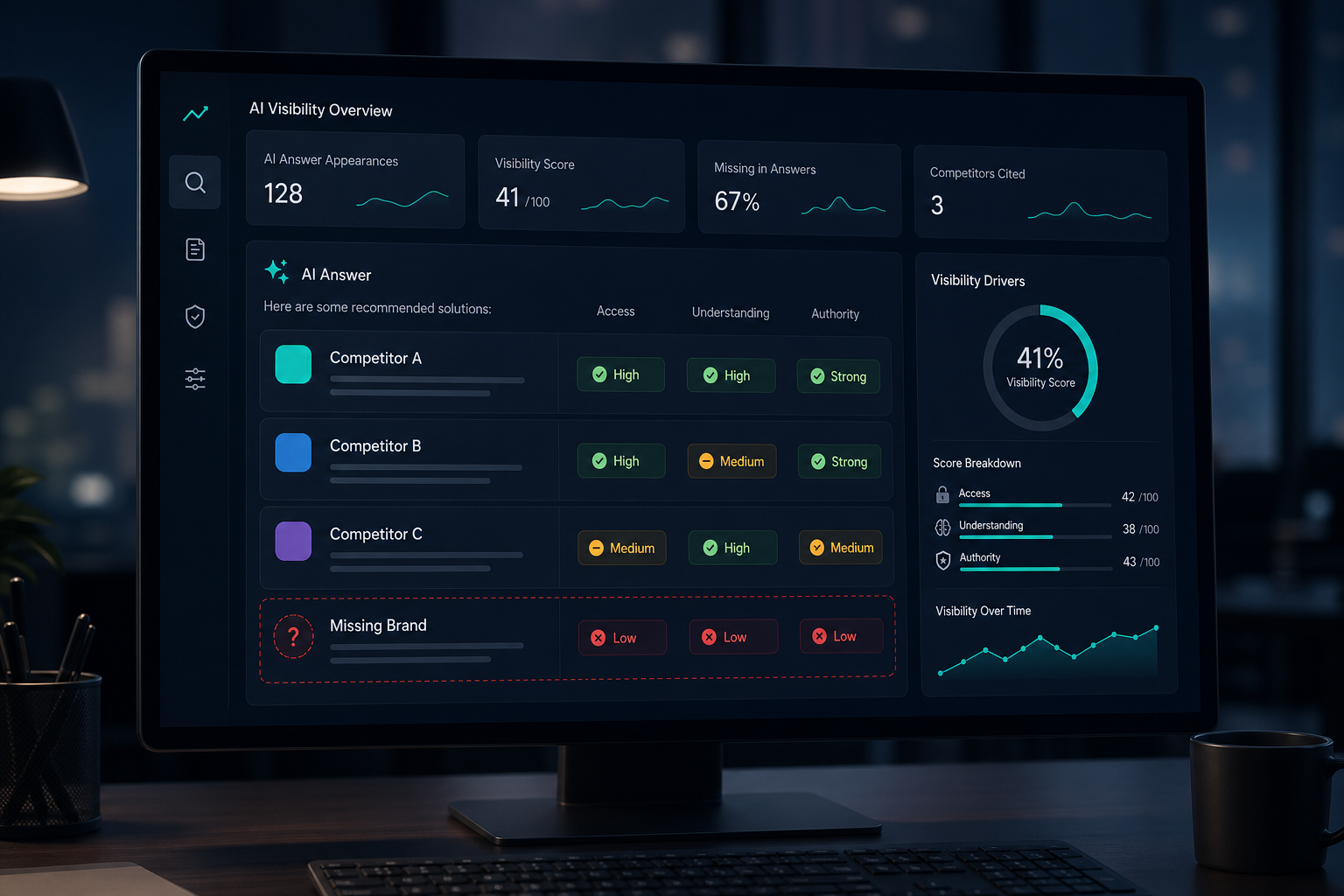
Your competitor just appeared in a ChatGPT answer for a buying question in your category. Your brand did not.
That moment feels personal, but it usually is not random. AI systems choose brands from the evidence they can access, understand, and trust. If a competitor has clearer pages, stronger third-party corroboration, cleaner entity signals, or fewer access problems, they can appear even when your traditional SEO report looks healthy.
This is why the first move should not be publishing ten more blog posts or rewriting every service page. The first move is diagnosis. You need to know whether the gap is technical access, answer structure, entity clarity, authority, or prompt coverage. Each cause leads to a different fix.
Key takeaways
- Competitors usually appear because AI systems have more usable evidence for them, not because one keyword ranking changed.
- The gap usually falls into Access, Understanding, or Authority.
- Third-party corroboration often matters as much as owned content.
- A single ChatGPT answer is not enough; test a prompt matrix across platforms.
- An AI Visibility Audit should identify the blocker before your team spends time on fixes.
Short answer: competitors win when AI systems have more usable evidence
Competitors show up in ChatGPT when AI systems have more usable evidence for them than they have for you. That evidence can come from their own site, but it can also come from review platforms, comparison pages, publisher coverage, community discussions, partner listings, and other sources that make the brand easier to verify.
The problem is not always that their company is better. It is often that their evidence is easier to retrieve and cite. OpenAI's crawler documentation makes the access layer concrete: OAI-SearchBot is the user agent used to surface websites in ChatGPT search features, and OpenAI says sites opted out of OAI-SearchBot will not be shown in ChatGPT search answers, apart from possible navigational links (OpenAI). Google describes AI features in Search as part of Search and says Googlebot crawling controls are the relevant access control for those features (Google Search Central). Perplexity says PerplexityBot follows robots.txt and will not index blocked text content (Perplexity).
That is only the access layer. Once a system can reach the evidence, it still has to understand what you do, decide whether your brand is credible, and match you to the buyer prompt. That is why Uygen uses three buckets for diagnosis: Access, Understanding, and Authority.
Diagnostic table: why competitors may be winning AI answers
| Possible cause | What you see | First diagnostic check |
|---|---|---|
| Access gap | Your site is rarely cited or retrieved | Robots.txt, OAI-SearchBot, Googlebot, PerplexityBot, sitemaps, indexing, rendering |
| Understanding gap | AI answers misdescribe or skip your offer | Priority-page headings, answer-first passages, schema, entity consistency |
| Authority gap | Competitors are cited from outside sources | Review sites, comparison pages, industry media, community mentions, partner profiles |
| Prompt gap | You appear for branded queries but not buyer queries | Prompt matrix by problem, category, competitor, and use case |
The five reasons competitors appear and you do not
The useful way to investigate competitor visibility is to map every missing mention to a likely cause. One answer from ChatGPT is not enough. You need a pattern across prompts, platforms, competitors, and cited sources.
1. AI systems can access their evidence more easily
Access is the first failure point. Your site can be available to normal visitors and still create friction for AI retrieval. The common issues are blocked user agents, stale sitemaps, pages missing from important indexes, heavy rendering dependencies, bot protection that treats AI crawlers as suspicious, or canonical rules that point systems away from the page that actually explains the offer.
This matters because AI visibility is not one platform. ChatGPT, Perplexity, Gemini, and Google AI surfaces do not all discover and use the web the same way. A brand can be technically fine for one surface and weak on another. A clean SEO crawl does not prove that ChatGPT search, Perplexity, and Google AI features have the same usable access to your best evidence.
2. Their pages answer buyer prompts more directly
AI systems are looking for passages they can use. If your competitor has a page that says who the product is for, what problem it solves, where it is available, what proof supports it, and how it compares, that page is easier to summarize than a vague brand page.
Many companies bury the useful answer under positioning copy. They describe the mission, the platform, the values, and the vision before saying the plain thing a buyer asked for. A competitor with a less polished but more direct page may be easier for AI systems to extract. Semrush's competitor-focused AI search guidance makes a similar point: authority signals matter, but content that is easier for AI systems to read and understand has a better chance of appearing in AI outputs (Semrush).
The fix is not making every page robotic. It is making key facts explicit: category, audience, use cases, locations, integrations, proof, limitations, and next steps.
3. Their brand entity is clearer
AI systems need to know what your brand is. If your website says one thing, your listings say another, your comparison pages use an old category, and your profiles have inconsistent names or descriptions, the model has to reconcile messy evidence. Competitors with consistent descriptions across the web are easier to classify.
Entity clarity is especially important for companies in crowded categories. If your brand name overlaps with another company, product, acronym, local business, or generic phrase, you need stronger disambiguation. That means clear organization schema, consistent naming, specific service pages, recognizable leadership or location signals where relevant, and external profiles that describe the same company in the same category.
4. They have stronger third-party corroboration
Your website says what you want to be true. Third-party sources help AI systems decide whether others also treat it as true. Review sites, analyst pages, app marketplaces, local profiles, comparison articles, partner directories, podcasts, Reddit threads, YouTube reviews, industry publications, and customer stories can all become corroborating evidence.
This is where many brands lose to competitors. They have invested in owned content but ignored the wider source ecosystem. Similarweb's AI visibility guidance frames the issue as topic ownership: if AI systems repeatedly see competitors associated with the category across authoritative sources, those competitors can become the default answer (Similarweb).
The audit question is not simply, "Do we have backlinks?" It is, "When AI systems look outside our site, do they find enough reliable evidence that we belong in this answer?"
5. They own the prompt category, not just the keyword
Traditional SEO trains teams to think in keywords. AI search behaves more like prompt coverage. A buyer might ask for "best tools for X," "alternatives to Y," "who should I hire for Z," "companies like A but for B," or "what vendor solves this problem for a mid-market team."
Your competitor may not be winning one exact keyword. They may be present across many adjacent prompts. That breadth matters because AI answers are unstable. One query run can produce a different list than the next. The stronger signal is not a single appearance; it is repeated inclusion across a prompt set that matches the buyer journey.
How to tell which blocker is actually causing the gap
Start with a prompt matrix, not a guess. Test the questions buyers actually ask across ChatGPT, Perplexity, Gemini, and Google AI surfaces where relevant. Record whether your brand appears, how it is described, which competitors appear, and which sources are cited.
Then group the evidence. If your brand is absent everywhere and your pages are hard to retrieve, start with Access. If your site is retrievable but AI answers misclassify the company, start with Understanding. If your site is clear but competitors are repeatedly cited from review platforms, publisher lists, and community discussions, start with Authority.
A practical diagnosis should include:
- prompt coverage by platform and query type
- competitor mentions and citation sources
- AI crawler and robots.txt checks
- sitemap, canonical, indexing, and renderability checks
- priority-page extractability review
- entity consistency across owned and third-party sources
- source ecosystem gaps where competitors have evidence and you do not
This is the same reason Google ranking alone is not enough. A page can rank and still fail the AI visibility test. For the deeper version of that problem, see Uygen's guide to why Google rankings do not guarantee ChatGPT visibility.
What not to do first
Do not start by mass publishing generic AI-optimized content. If the blocker is crawler access, more content just gives AI systems more pages they still cannot use. If the blocker is authority, more owned content may not solve the lack of third-party corroboration. If the blocker is entity confusion, new pages can make the signal messier.
Do not chase guaranteed ChatGPT mentions. A credible provider can test prompts, document competitor patterns, identify blockers, and prioritize fixes. No one can honestly force ChatGPT, Perplexity, Gemini, or Google AI to replace a competitor with your brand on command. Uygen's article on what an AI Visibility Audit cannot guarantee explains where the line should be.
Do not overreact to one answer. AI responses vary. The useful question is whether the same competitors appear repeatedly across the prompts that matter to revenue.
What an AI Visibility Audit should show you
A useful audit should turn competitor anxiety into an evidence-backed roadmap. It should show where your brand appears today, where it is absent, which competitors are being surfaced instead, and which source types are influencing those answers.
The deliverable should not be a loose list of tips. It should separate findings into Access, Understanding, and Authority, then show the top fixes worth doing first. For some brands, the first fix is technical. For others, it is rewriting priority pages so AI systems can extract the offer. For others, it is building corroboration outside the website.
For a Shopify store, that is the role of Uygen's monthly SEO + GEO service. It checks whether AI systems can access, understand, and trust your brand every month, then fixes what it finds by hand and publishes new articles — not just a report. If you want the full deliverable breakdown, read what an AI visibility audit includes.
FAQ
Why do competitors appear in ChatGPT but my brand does not?
Usually because ChatGPT and other AI systems have more usable evidence for the competitors. That evidence may be easier to access, clearer to extract, more consistent across the web, or better supported by third-party sources.
Can we rank in Google and still be absent from ChatGPT?
Yes. Google ranking and AI answer visibility overlap, but they are not the same measurement. A page can rank well and still fail because of weak AI crawler access, poor answer structure, unclear entity signals, or limited external corroboration.
Should we publish more content to fix the problem?
Only after diagnosis. More content helps when the gap is missing coverage or weak extractability. It does not solve blocked access, entity confusion, or a lack of trusted third-party evidence by itself.
Can an audit guarantee that ChatGPT will replace competitors with us?
No. A credible AI visibility audit can measure the current gap, identify blockers, and prioritize fixes, but it cannot guarantee a specific AI answer or force a platform to cite your brand.
When competitors show up in ChatGPT and your brand does not, the wrong response is panic publishing. The useful response is diagnosis. Find out whether the gap is Access, Understanding, Authority, or prompt coverage, then fix the constraint that is actually keeping your brand out of the answer.