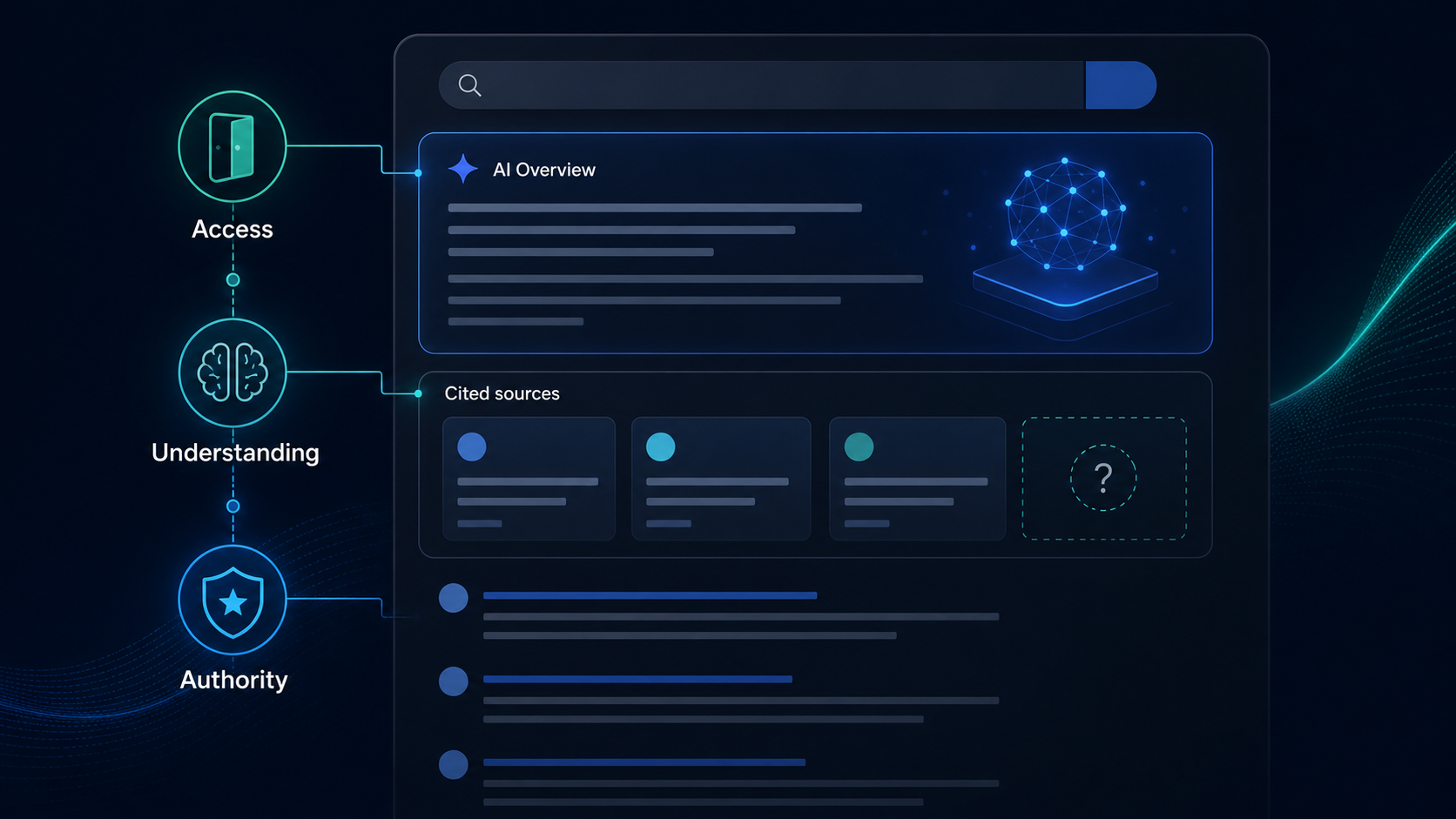
Quick answer: If content is missing from AI Overviews, Google usually lacks one of three things: clean access to the page, a direct extractable answer, or enough corroborating authority to trust the source. Check whether the query triggers an AI Overview, then diagnose access, understanding, and authority in that order.
If you are not showing up in Google AI Overviews, the problem is usually not one magic ranking factor. Google has to access your page, understand the answer on it, and trust the source enough to cite or reference it in an AI-generated result.
That means a page can rank in normal Google results and still be absent from the AI Overview above it. The page may be blocked from full crawling, too vague for extraction, misaligned with the query, weak on entity signals, or outranked by sources Google sees as more authoritative for that answer.
This article diagnoses brand-level absence. If a specific URL already ranks but Google is not selecting its content as a source, use the focused guide to why content is missing from Google AI Overviews.
This guide uses the same diagnostic frame we use in an AI Visibility Audit: access, understanding, and authority. Use it before you rewrite pages, publish more content, or chase generic "AI SEO" tactics.
Key Takeaways
- Google says the fundamentals of Search carry into AI experiences: useful content, crawlable pages, good page experience, accurate structured data, and clear visibility controls.
- AI Overview absence is usually a diagnostic problem, not a content-volume problem.
- The query "content missing from AI Overviews" is a page-1/2 opportunity for this topic, so the page should answer that exact problem immediately.
- Start with access checks: Googlebot, indexability, HTTP status, canonicalization, robots directives, snippet controls, and whether the query actually triggers an AI Overview.
- Then check understanding: direct answers, clear headings, visible schema alignment, entity clarity, and passages that can stand alone.
- Finally check authority: topical depth, original evidence, third-party corroboration, reviews, profiles, and whether stronger sources already own the answer.
- AI Overviews pull passages, not pages. A mid-authority site with a tight, direct answer in the first paragraph can beat a high-authority site that buries the answer in paragraph six.
- Schema markup does not reliably improve AI Overview inclusion. Prose structure matters more than structured data wrappers.
Short answer: Google does not have enough usable evidence
You are not showing up in Google AI Overviews because Google does not have enough usable evidence to include your page or brand in that answer. The evidence may be inaccessible, hard to extract, weakly matched to the query, or less trusted than competing sources.
Think of AI Overview visibility as a three-gate system:
| Gate | What Google needs | Common failure |
|---|---|---|
| Access | The page can be crawled, indexed, rendered, and previewed | Robots rules, noindex, canonical conflicts, blocked assets, weak indexing |
| Understanding | The page gives a clear answer Google can extract | Buried answers, vague headings, thin examples, mismatched schema |
| Authority | The source is credible enough for the query | Weak topical footprint, few corroborating mentions, stale or generic content |
Google's own guidance for AI experiences says site owners should make sure Google can crawl and index pages, provide useful content, maintain a good page experience, and use preview controls carefully because restrictive settings can limit how content appears in AI formats. That guidance is not a promise of inclusion. It is the baseline for being considered.
The practical point: do not start by asking, "How do we rank in AI Overviews?" Start by asking, "Which gate is failing for this query?"
First, confirm there is an AI Overview to win
Not every query triggers an AI Overview, and Google changes when it shows one. Before diagnosing your site, confirm the search result actually contains an AI Overview in your market, device type, and query wording.
This sounds basic, but it prevents wasted work. A brand may search one broad keyword, see no AI Overview, and assume it is invisible. Then a longer buyer question in the same topic may trigger an overview with competitors cited. The opportunity lives at the prompt level, not just the keyword level.
Check three query types:
- The exact target keyword, such as "content missing from AI Overviews" or "why not in Google AI Overviews."
- Buyer-problem questions, such as "why does my competitor show in AI Overview but not me?"
- Category queries, such as "best [service type] for [use case]."
Log whether an AI Overview appears, which domains are linked, whether your brand is mentioned, and whether competitors appear. If no AI Overview appears for the query set, the issue may be prioritization rather than optimization. If competitors appear and you do not, move through access, understanding, and authority.
Access: can Google use the page in AI experiences?
Access is the first gate because a blocked or poorly indexed page cannot be selected for an AI Overview. If this gate fails, content changes downstream will not matter.
Google's AI experiences are still part of Google Search. In its Search Central guidance, Google says pages need to meet technical requirements so Google can find, crawl, index, and consider them for results, including AI formats. It specifically calls out Googlebot access, a successful HTTP status, and indexable content.
Run these checks before editing copy:
| Access check | What to look for | Why it matters |
|---|---|---|
| HTTP status | Priority URL returns 200 | Non-200 pages are poor candidates for citation |
| Robots.txt | Googlebot is not blocked | Blocking Googlebot blocks normal Search and AI eligibility |
| Meta robots | No accidental noindex or restrictive preview control | Noindex removes the page; snippet controls can limit AI display |
| Canonical | Canonical points to the intended URL | Google may consolidate signals elsewhere |
| Indexing | URL is indexed for the target market | Non-indexed pages cannot reliably appear |
| Rendered content | Main answer appears in crawlable HTML | Hidden or client-only content can weaken extraction |
Pay special attention to preview controls. Google says site owners can use nosnippet, data-nosnippet, max-snippet, and noindex to control how content appears, and that more restrictive permissions can limit inclusion in AI experiences. That is useful when you intentionally want control. It is damaging when old templates apply those controls by accident.
Access also includes page experience. If the main answer is buried behind interstitials, heavy scripts, tabs that do not render cleanly, or layouts where the main content is hard to distinguish, Google may have enough data to index the page but not enough clean content to use confidently.
Understanding: does the page answer the query clearly?
Understanding is the second gate. Google may be able to crawl your page and still choose another source because that source gives the answer in a cleaner, safer, more extractable format.
Pages that miss AI Overviews often have one of these problems:
- The answer appears only after a long introduction.
- Headings are clever rather than descriptive.
- The page targets a keyword but not the user's actual question.
- Schema markup describes content that is not visible on the page.
- The brand, product, audience, and use case are not stated plainly.
- The article repeats generic advice without examples or decision criteria.
The fix is not to stuff the phrase "Google AI Overviews" into every section. The fix is to create answer blocks that can stand alone.
The most reliably cited pages share one structural feature: a Quick Answer block. This is 40 to 60 words at the top of the article that directly answers the main question, written so a model can lift it without rewriting. If the answer is buried in paragraph six behind three paragraphs of preamble, a competing page with a cleaner opening gets extracted instead, even if your page ranks higher.
Question-format H2 headings compound this. Practitioner notes in the local wiki repeatedly point to the same pattern: AI Overviews prefer sections that match the question a user asks. A heading like "Why is my content missing from AI Overviews?" is easier to match than a clever label like "Visibility gap."
A good AI Overview candidate section usually has this shape:
- A direct answer in the first sentence.
- A short explanation of why the answer is true.
- A concrete example, checklist, or comparison table.
- Clear entity names: brand, product, category, audience, location, and use case where relevant.
- Internal links to supporting pages that deepen the topic.
For example, a service page that says "We help companies grow with AI" is hard to classify. A page that says "Uygen audits whether ChatGPT, Perplexity, Gemini, and Google AI can access, understand, and trust a B2B brand's evidence" is much easier for AI systems and search systems to interpret.
On structured data: schema is a clarification layer, not a citation driver. If your schema matches visible page content and follows Google's guidelines, keep it, but do not rely on it to fix a buried-answer problem. What usually moves the page is a clearer answer block, stronger examples, and evidence the model cannot find everywhere else.
Authority: does Google trust you enough for this answer?
Authority is the third gate. If several accessible pages answer the query clearly, Google still has to decide which sources are reliable enough to support an AI-generated answer.
This is where many brands over-focus on their own blog. Publishing another article may improve topical depth, but AI visibility also depends on the wider evidence ecosystem around the brand. Google can see your website, but it can also see reviews, profiles, references, citations, news coverage, documentation, social discussions, and other third-party sources.
Authority gaps show up in patterns like these:
- Competitors are mentioned by industry publications and you are not.
- Review platforms have thin, stale, or inconsistent profiles for your brand.
- Your category pages make claims that no external source corroborates.
- Your site has one article on a topic while competitors have a connected content cluster.
- Your brand name, product name, and category labels are inconsistent across the web.
For AI Overviews, authority is not just link equity. It is whether the brand is a clear, corroborated entity in the topic being answered. A page can be well optimized and still lose to a source with stronger topical history, original data, or third-party validation.
This is why an audit should inspect the source ecosystem, not only the page. The question is not "Does the page mention the keyword?" It is "Would Google have enough corroborating evidence to treat this brand as a useful source for this answer?"
Why ranking in Google is not the same as appearing in AI Overviews
Traditional rankings and AI Overview inclusion overlap, but they are not identical. A normal ranking means Google considers the page relevant enough to place in the organic results. AI Overview inclusion means Google considers a passage, page, or source useful enough to support a synthesized answer.
Those are different jobs.
A page can rank because it has broad relevance, backlinks, domain strength, or historical performance. But an AI Overview may prefer a competing page that answers the specific question faster, uses cleaner definitions, includes more recent evidence, or has clearer topical authority.
The reverse can also happen. A lower-ranking page may be cited because it contains one strong answer block that fits the generated summary. AI Overviews pull passages, not pages. A mid-authority site with a tight, direct answer in the first paragraph can beat a high-authority site that buries the answer.
The structural reason is that the same extractability signal that earned featured snippets for years now determines AI Overview inclusion. If you had a featured snippet and lost it, you likely have an understanding gap. If you never had one for the target query, that is often the same reason you are absent from the AI Overview.
For a broader version of this problem across AI search, see our guide on why Google rankings do not guarantee ChatGPT visibility. The same principle applies here: ranking is evidence, not a guarantee.
Why content disappears from AI Overviews after appearing
Some brands diagnose the problem correctly, appear in AI Overviews briefly, and then disappear. This is different from never appearing, and the causes are different.
The most common reasons for losing an AI Overview citation after gaining one:
- A competitor published a cleaner answer. AI Overviews continuously re-evaluate which source best fits the query. A competitor page with a tighter Quick Answer block can displace you even if you previously ranked higher and appeared first.
- The page was updated and the answer block shifted. If you added new content above the direct answer, or restructured the page so the key passage moved lower, Google's extraction may return a worse match and prefer another source.
- Google's AI Overview for the query changed or disappeared. Not every query triggers an AI Overview consistently. Google changes when AIOs appear by query type, geography, and model update. Before diagnosing a drop, confirm the overview still shows for the query and market.
- A technical change accidentally introduced a snippet control. A template update, CMS change, or new plugin adding
nosnippetormax-snippetdirectives can remove previously included content from AI experiences without any content change. - Authority signals weakened relative to competitors. If a competitor gained new reviews, press coverage, directory listings, or community discussions while yours stayed static, relative authority can shift even without any page-level change.
If content was appearing and stopped, the fastest diagnostic is: did the query still trigger an AI Overview? Did a technical directive change? Did a competitor page become more extractable? Check in that order before rewriting content.
A quick diagnostic checklist
Use this checklist before you rewrite the page.
| Diagnostic question | Gate | What to do next |
|---|---|---|
| Does the query currently trigger an AI Overview? | Opportunity | Track the exact query set before optimizing |
| Is the target page indexed and returning 200? | Access | Fix crawl, index, canonical, or status issues |
| Are robots or snippet controls limiting Google? | Access | Review robots.txt, meta robots, and snippet directives |
| Does the first section answer the query directly? | Understanding | Rewrite the opening into a direct answer block |
| Are headings descriptive and question-aligned? | Understanding | Replace clever labels with clear H2/H3s |
| Does schema match visible content? | Understanding | Remove mismatched markup; validate structured data |
| Do competitors have stronger external evidence? | Authority | Build source ecosystem coverage, not only more posts |
| Is the brand entity consistent across the web? | Authority | Align profiles, descriptions, categories, and citations |
If you fail an access check, fix that first. If access is clean, move to understanding. If the page is clear and still absent while competitors appear, authority is likely the constraint.
What not to do first
Do not start by mass-publishing new posts. More content does not fix blocked crawling, weak entity clarity, or a lack of third-party corroboration.
Do not promise your team guaranteed AI Overview placement. Google controls whether an AI Overview appears, what it says, and which sources it links. A credible audit can identify blockers and improve eligibility, but it cannot force inclusion.
Do not treat one search result as the whole market. AI Overview behavior changes by query wording, location, personalization, device, and timing. You need a tracked query set, not one screenshot.
Do not copy competitor structure blindly. Competitors may be winning because of authority signals you cannot see from the page alone. If you copy their headings but lack their evidence ecosystem, you may still be absent.
What an AI Visibility Audit should show you
A useful audit should tell you why you are missing, not just list generic AI SEO tips.
For Google AI Overviews, the audit should include:
- A prompt and query baseline showing where AI Overviews appear.
- A citation map showing which competitors and sources are linked.
- Access checks for crawlability, indexability, preview controls, rendering, and structured data.
- Understanding checks for answer structure, entity clarity, schema alignment, and extractable passages.
- Authority checks across third-party mentions, reviews, profiles, topical depth, and source consistency.
- A prioritized roadmap that separates fast technical fixes from slower authority work.
That is the difference between "optimize for AI Overviews" as a vague content project and a diagnostic workflow that can produce a fix order.
For a fuller breakdown of deliverables, see what an AI visibility audit includes and our Shopify AI visibility tracking guide.
Book an AI Visibility Audit ->
FAQ
Why am I not showing up in Google AI Overviews?
You are usually missing because Google cannot access the page cleanly, cannot extract a direct answer from it, or does not trust the source enough compared with competitors. Start with crawl and index checks, then review answer structure, then inspect authority signals.
Can I rank on page one and still miss the AI Overview?
Yes. Page-one ranking can help, but it does not guarantee AI Overview inclusion. AI Overviews need source material that fits a synthesized answer, so extractability, query fit, and authority can change which sources are used.
Does schema help with Google AI Overviews?
Schema can help Google understand content, but it is not a shortcut. It should match visible page content and follow Google's structured data guidelines. Use it to clarify articles, FAQs, products, organizations, and services that are already clear on the page.
Should I block Google from using my content in AI Overviews?
Only if that is an intentional content policy decision. Google provides preview controls such as nosnippet, data-nosnippet, max-snippet, and noindex, but restrictive settings can limit how content appears in AI experiences.
How long does it take to appear in AI Overviews after fixes?
Access and structure fixes can be reflected after Google recrawls and reprocesses the page, but there is no fixed timeline or guaranteed inclusion. Authority improvements usually take longer because they depend on external evidence and topic coverage compounding over time.
Does adding schema markup help me appear in AI Overviews?
Not reliably. AI Overviews pull from prose content. The better lever is restructuring the page so the direct answer appears in the first 40 to 60 words, then supporting that answer with original evidence and corroborating sources.
I had an AI Overview citation and lost it. What happened?
The most common causes: a competitor published a cleaner, more extractable answer for the same query; a content or template change moved your direct answer lower on the page; a technical directive such as nosnippet or max-snippet was accidentally introduced; or Google changed when the AI Overview fires for that query type. Check whether the overview still appears for the query before diagnosing the page.
Missing from Google AI Overviews is not a single-problem diagnosis. It is usually an access, understanding, or authority gap. Find which gate is failing for the specific query set, fix that gate first, and measure changes over time. That is the practical path; everything else is guesswork.
Run a Shopify store? See what SEO + GEO looks like, done for you.
One flat price covers a monthly audit, on-page fixes, and new articles written for Google and AI answer engines.