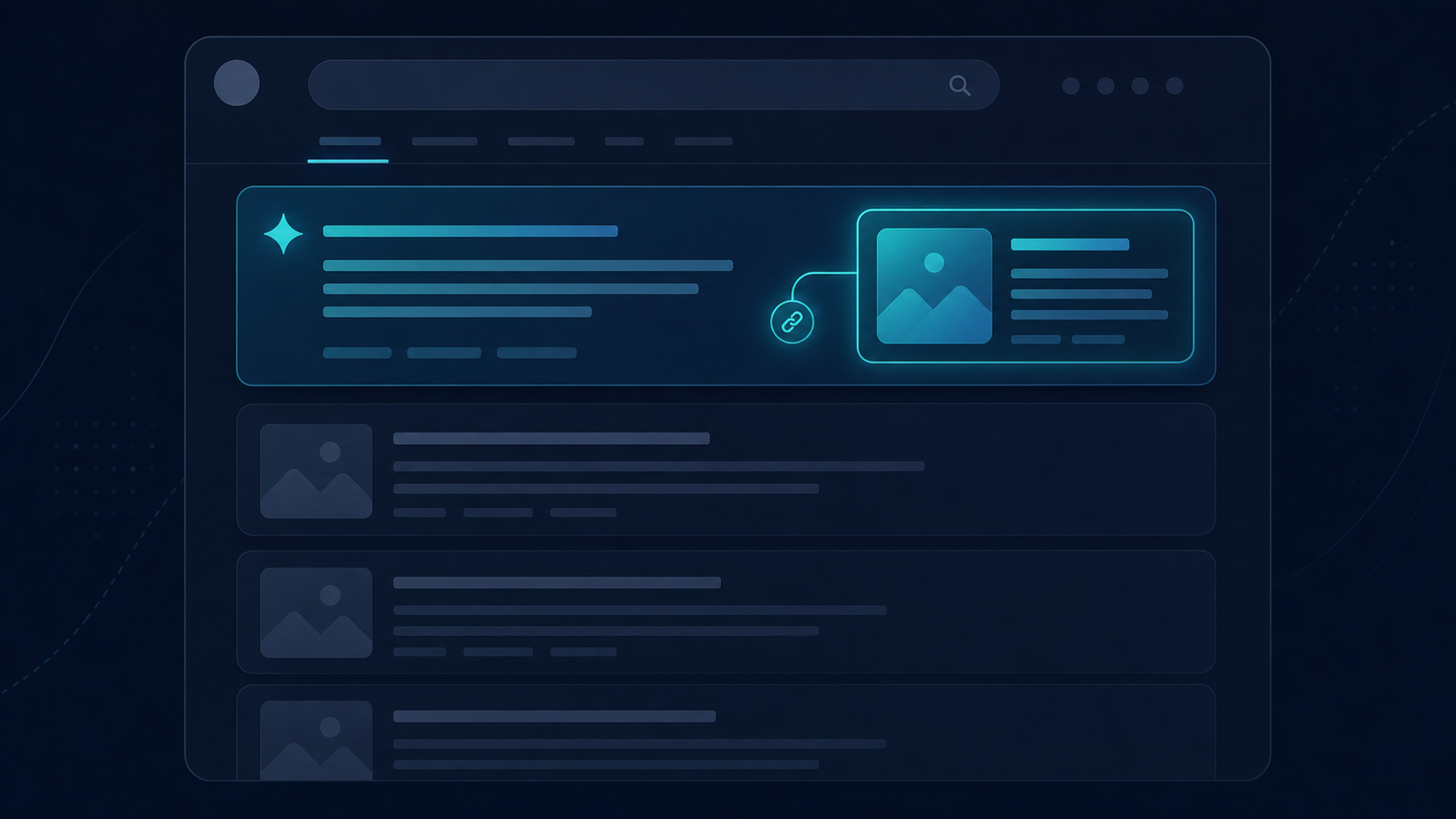
You rank on page one. Your content is thorough and accurate. And yet, when someone asks Google the exact question your page answers, the AI Overview summarizes a competitor and links to them — not you.
Ranking and being cited in an AI Overview are two different outcomes with two different requirements. Most pages are eligible to be cited and never are, because they were built to be read top to bottom, not lifted in pieces. AI Overview optimization is the work of closing that gap. This guide covers five on-page tactics that change how often Google's AI pulls your page into an Overview — and how to tell whether they are working.
If your problem is that you are not appearing at all, start with the diagnostic side first: why your brand is not showing in Google AI Overviews covers access and root causes. This post assumes you already rank and focuses on the changes that turn a ranking page into a cited one.
Key Takeaways
- → AI Overview optimization is a layer on top of ranking, not a replacement: around 76% of AI Overview citations come from pages already in the organic top 10.
- → The highest-leverage on-page tactic is answer placement — lead each section with a 40–60 word direct answer the AI can lift.
- → Schema only helps when it mirrors visible content; FAQPage markup correlates with pages being roughly 3.2x more likely to surface in AI Overviews.
- → Snippet controls (nosnippet, max-snippet, data-nosnippet) can silently cap what Google is allowed to preview.
- → On-page tactics cap out without third-party corroboration — the Authority layer, and the slowest to move.
What is AI Overview optimization?
AI Overview optimization is the practice of structuring an already-indexed, already-ranking page so Google's AI can extract a clear, self-contained answer and cite it inside an AI Overview. It does not replace SEO. Roughly 76% of AI Overview citations come from pages already ranking in the organic top 10, so this work sits on top of ranking — not instead of it.
It helps to separate two questions. "Can Google find and rank my page?" is an SEO question. "Can Google's AI lift a trustworthy answer from my page and attribute it to me?" is an AI Overview question. The five tactics below assume the first is already true. For the broader optimization checklist, our guide on how to optimize for Google AI Overviews covers the full picture; this post drills into the specific on-page moves that change citation rate.
At Uygen we frame AI visibility in three layers — Access, Understanding, and Authority. Tactics 1 to 3 sharpen Understanding, so AI can extract a clean answer. Tactic 4 builds Authority inside your own domain. Tactic 5 extends it beyond your site.
Tactic 1: Restructure your opening as a direct-answer passage
The most consistent pattern across cited pages is answer placement. AI Overviews are assembled from short, self-contained passages, so the page that states its answer first gets lifted, and the page that builds to its answer over five paragraphs gets skipped.
Lead each section with a 40 to 60 word direct answer immediately after the heading. Write the heading as the question a user would actually ask, then answer it plainly in the first two or three sentences. Save the context, caveats, and examples for the paragraphs underneath.
This is not about making content shallow. It is about ordering it so the extractable answer sits at the top of each chunk. A page can be deep and still lead with the answer in every section — the depth lives below the summary, reinforcing trust without burying the citation-ready sentence. A useful test: for every H2, ask "if Google could quote only two sentences from this section, which two would I want?" Put those two first.
Tactic 2: Align schema to visible content (not just add it)
Structured data raises extraction probability, but only when it describes what is actually on the page. Pages with comprehensive schema are roughly 36% more likely to be cited, and FAQPage markup in particular is associated with pages being about 3.2x more likely to surface in AI Overviews, according to Frase's analysis of FAQ schema for AI search .
The mistake is treating schema as a checkbox. Marking up an FAQ that does not appear on the page, or describing a product differently in your JSON-LD than in the visible copy, creates a mismatch that AI systems discount rather than trust.
Get the basics right: FAQPage schema for question-and-answer sections that genuinely exist on the page, Article schema with a named author, and Organization schema with sameAs links to your verified profiles. Use JSON-LD, connect entities with @id, and only mark up content a reader can actually see. Schema's job is to confirm the structure already present in your copy — not to smuggle in claims the page does not make.
Tactic 3: Fix snippet controls that limit Google's preview
An AI Overview can only use what Google is allowed to preview. If your pages carry a nosnippet directive, a restrictive max-snippet value, or data-nosnippet wrappers around key passages, you are capping how much of your content Google can lift — and sometimes excluding the page from the Overview entirely.
This is the quietest blocker, because it usually was not a deliberate choice. Snippet limits get inherited from old SEO templates, security plugins, or a blanket setting applied years ago to control how content appeared in classic search results.
Audit the robots meta tag and HTTP headers on your priority pages. Unless you have a specific reason not to, allow a generous max-snippet — or set it to -1 — so Google can preview enough to build a complete answer. If you use data-nosnippet, confirm it is not wrapping the exact passages you most want cited. These technical-access checks overlap with the AI crawlability work covered in our guide to llms.txt .
Tactic 4: Build topical authority with a content cluster, not a single page
Google's AI weighs whether your site is a credible source on a topic, not just whether one page answers one query. A single strong page in isolation is easy to overlook; the same page surrounded by related, internally linked content reads as the authoritative treatment of the subject.
Build clusters: a primary page on the core topic, supporting pages on the sub-questions, and clear internal links between them. Internal linking is part of how Google's AI infers which page is the definitive answer within your domain, so link with descriptive anchors that name the topic rather than generic "click here" text.
Freshness compounds the effect. Google weights recency, so a quarterly refresh is a reasonable minimum for pages you want consistently cited. One documented program that combined systematic refreshes with schema and updated statistics moved a site's citation rate from 12% to 47%, per ZipTie's content refresh case study . Content structure, not raw domain authority, tends to decide citations — which is why a smaller, well-structured site can be cited over a larger one.
Tactic 5: Strengthen third-party corroboration for the query topic
On-page tactics have a ceiling. AI systems cross-check what a brand says about itself against what independent sources say — reviews, directories, your Google Business Profile, and mentions on sites the model already trusts. When those external signals agree with your page, the AI has reason to cite you with confidence. When they are thin or contradictory, even a well-structured page struggles.
You cannot directly control what third parties publish, but you can give them accurate, consistent information to work from: a complete and current Google Business Profile, consistent name and category details across directories, and original data or claims that other sites have a reason to reference.
This is the Authority layer, and it is the slowest to move — which is also why it is where many brands quietly lose ground. A page can be perfectly structured and still be passed over because the wider source ecosystem does not yet corroborate it.
How to measure whether AI Overview optimization is working
AI Overview citation is not a single number in a dashboard, so measure it deliberately. Build a fixed set of the queries you want to be cited for — your category, your services, your competitor comparisons — and check them on a schedule.
Track three things over time: whether an AI Overview appears for each query, whether your brand is cited or linked in it, and which competitors are cited instead. Run the same set every two to four weeks so you can see movement rather than a single snapshot. Pair this with referral data: AI surfaces send fewer clicks than classic search, so a flat click count alongside rising citations is still progress, not failure. See the current zero-click data for how much clickthrough an AI Overview citation costs by content type. The Averi 2026 AI Overview playbook documents the same ranking-to-citation pattern these checks reveal.
If your spot-checks keep showing competitors cited where your brand should be, the useful question is which layer is blocking you — Access, Understanding, or Authority.
Run a Shopify store? See what SEO + GEO looks like, done for you.
One flat price covers a monthly audit, on-page fixes, and new articles written for Google and AI answer engines.
Frequently asked questions
Why does my page rank but not appear in an AI Overview?
Ranking proves Google can find and trust your page enough to list it. An AI Overview citation requires something more specific: a short, self-contained passage the AI can lift and attribute. If your answer is buried below context, or your schema does not match the page, you can rank well and still be skipped.
Does schema markup help you appear in AI Overviews?
Yes, when it mirrors visible content. FAQPage and Article schema help AI systems extract and verify answers, and comprehensive schema correlates with higher citation rates. Schema that describes content not present on the page works against you, because the mismatch reduces trust.
How long does it take to appear in an AI Overview?
It varies. Technical fixes like snippet controls and schema can take effect within days of recrawling. Answer restructuring and content clusters take weeks. Third-party corroboration is the slowest layer and can take months. A small, well-structured local site has been cited within days of a structured rebuild, but that is the fast end of the range.
Is AI Overview optimization just SEO with extra steps?
It builds on SEO but is not the same. SEO earns the ranking; AI Overview optimization makes that ranking page extractable and citable. You need both — most pages that miss AI Overviews already rank and simply were not structured to be lifted.
Where to start
AI Overview optimization is not a separate discipline from SEO — it is the layer that decides whether your ranking turns into a citation. Lead with the answer, make schema match the page, stop capping your own snippets, build a cluster, and earn outside corroboration.
If your spot-checks keep showing competitors in the Overview where your brand should be, the question is which layer — Access, Understanding, or Authority — is actually blocking you. An AI Visibility Audit diagnoses exactly that across your site and wider source ecosystem, then gives you a prioritized roadmap of what to fix first.