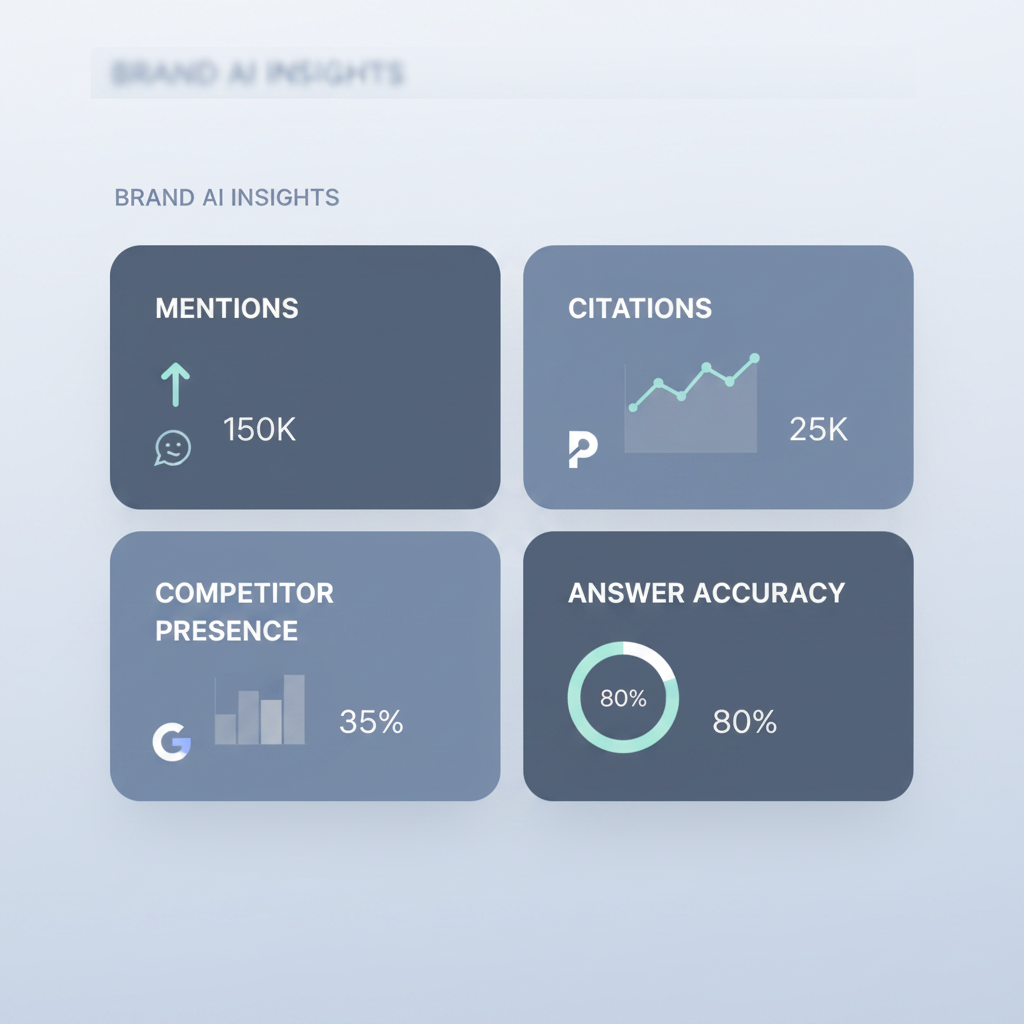
Quick answer: To track AI search visibility, build a fixed set of 20–50 prompts across branded, category, problem-aware, comparison, and proof-seeking queries. Run them monthly on ChatGPT Search, Perplexity, and Google AI Overviews. Record four metrics per run: brand mentions, brand citations, competitor presence, and answer accuracy. Calculate your citation rate. Below 10% signals effective invisibility; 20–30% is a solid operational baseline.
Most brands discover an AI visibility problem after the fact. A sales call where a prospect mentions they found a competitor through Perplexity. A quarter where organic traffic holds but demo requests drop. Neither moment gives you data. Without a measurement system, you cannot tell whether you have a citation gap, a content problem, a technical access issue, or an authority gap.
This playbook gives you a repeatable way to measure AI search visibility before you buy software or commission a full audit. It covers what to track, which platforms matter, how to build a prompt set, what to record, and how to score the results. A spreadsheet and 30 minutes get you a real baseline.
GSC reality check: buyer wording is converging around "AI results tracking," "track AI visibility," "AI search visibility tracking," and "how to monitor AI search visibility." Those are not separate strategies. They are the same business problem: knowing whether AI systems mention your brand, cite your domain, describe you accurately, and prefer competitors instead. Use that exact language in the tracking dashboard, report headings, and service-page copy so the page maps to how buyers now search.
You will see this work called different things — AI results tracking, generative AI tracking, AI search visibility tracking, or LLM citation monitoring. They all describe the same activity: checking whether AI answer engines mention, cite, and correctly describe your brand, then watching how that changes over time. The labels differ; the method below does not.
Key Takeaways
- Track four metrics separately: mentions, citations, competitor presence, and answer accuracy.
- Start with ChatGPT Search, Perplexity, and Google AI Overviews, the three platforms that drive most AI-influenced purchase decisions.
- Build a prompt set of 20 to 50 queries across five categories: branded, category discovery, problem-aware, comparison, and proof-seeking.
- Run each prompt at least three times per session to account for non-deterministic variance.
- Even brands with strong Google rankings appear in only 18% of AI answers on average — a citation rate below 10% means effective invisibility.
- AI citations are unstable: one analysis of 100,000 brands found they drift 40 to 60% per query each month, so a page can lose its cited spot within about eight weeks. Tracking has to be ongoing, not one-time.
- The pattern in your data tells you which layer to fix first: access, understanding, or authority.
AI results tracking vs. AI visibility tracking: what you're measuring
Two phrases get used for this work, and it helps to separate them before you start. AI results tracking — also called generative AI tracking — is the broad activity: watching what AI answer engines actually return for a set of queries, which brands they name, which sources they cite, and how those answers move over time. AI visibility tracking is the brand-specific slice of that same work: narrowing the method to one question — is your brand mentioned, cited, and described correctly in those answers?
In practice most teams use the terms interchangeably, and the method below serves both. You build one fixed prompt set, run it across the same platforms on a schedule, and record what comes back. The only difference is where you point the lens. Generative AI tracking maps the whole answer landscape for a category; AI visibility tracking scores your own presence inside it. This playbook does both at once — every run records competitor presence alongside your own, so the same spreadsheet answers "what is AI saying about this category?" and "where do we stand in it?"
Keep that distinction in mind as you read. When the data later shows a gap, knowing whether you are short on overall presence or specifically on your own citations is the first step toward diagnosing whether it is an access, understanding, or authority problem.
What you are actually measuring
"AI visibility" is too vague to act on. There are four distinct metrics, and each points to a different root cause.
| Metric | What it means | Why it matters |
|---|---|---|
| Mention | AI names your brand in the answer text | Signals entity recognition: the model knows you exist |
| Citation | AI links to a URL on your domain as a source | Signals source authority: the model trusts your pages as evidence |
| Competitor presence | Competitors appear in answers where you should | Reveals relative visibility: what you're losing, not just what you're missing |
| Answer accuracy | AI describes your brand, offer, and audience correctly | Signals understanding: wrong answers can damage buying decisions |
These metrics are not interchangeable. A brand can have a high mention rate and a low citation rate. ChatGPT names you, but it's pulling information from a competitor roundup that happens to reference you. A brand can have strong citations on one educational article while the service page is never retrieved. A brand can appear correctly in branded prompts and be entirely absent from every category and problem-aware query a real buyer would actually use.
Track all four separately before drawing any conclusion about what to fix. Yext's AI visibility framework maps to the same structure: presence, sentiment, and comparative position, three signals that correspond directly to mentions, accuracy, and competitor presence above.
The gap is larger than most teams expect. Google's May 2026 AI SEO guide found that even brands with strong Google rankings appear in only 18% of AI answers. Solid SEO does not translate automatically to AI visibility. That is exactly why tracking all four metrics separately matters: the problem is rarely in one place.
What "citation share," "share of model," and "share of voice" mean
Three related terms appear frequently in AI search tracking. They are not interchangeable:
- Citation share: your site's percentage of all citations for a given grounding query. Bing Webmaster Tools now reports this as a formal metric in its AI Performance dashboard — currently the closest thing to a GEO ranking signal available without a paid tool. Google Search Console does not have an equivalent.
- Share of model: how often your brand appears in AI-generated answers across a defined prompt set, expressed as a percentage of total runs. It normalises for the number of prompts and sessions, so it is comparable across time periods and competitors.
- Share of voice in AI: your brand's presence relative to competitors across a topic or category. A brand at 25% share of model against a competitor at 60% has a 58% relative gap — which is different from saying your absolute performance is weak.
These terms describe the same underlying measurement from different angles. When evaluating a tool that claims to report citation share, verify whether it is using Bing's formal definition (percentage of grounding query citations) or a proprietary proxy metric — they are not the same, and the distinction affects whether your numbers are comparable to industry benchmarks.
Which platforms to track
The same brand can perform very differently across AI search platforms. Frase's AI tracking guide and Search Engine Land both recommend testing across at least three: ChatGPT, Perplexity, and Google AI Overviews.
| Platform | How citations surface | Priority |
|---|---|---|
| ChatGPT Search | Inline citations and Sources panel when Search mode is active | Primary |
| Perplexity | Source panel on nearly every answer | Primary |
| Google AI Overviews | Embedded links in the Overview block above organic results | Primary |
| Gemini | Citations vary by query; web references appear in some answers | Secondary |
| Microsoft Copilot | Bing-indexed pages; inline citations in most answers | Secondary |
Start with the three primary platforms. They account for the largest share of AI-driven category and purchase-intent queries. Add Gemini and Copilot once your primary baseline is established.
Cross-platform divergence is normal and worth treating as its own finding. Being well-cited in Perplexity does not mean you appear in Google AI Overviews. The platforms use different source signals, different crawlers, and different retrieval logic. Treat each as a separate measurement track rather than collapsing them into a single score.
One Gemini-specific note: Gemini has been measured citing different sources approximately 65% of the time when asked the same question back-to-back — the highest variance of any major platform. Never draw conclusions from a single Gemini prompt. Run the same query at least five times before recording a result, and treat Gemini data with a wider confidence band than ChatGPT or Perplexity.
One thing most tracking guides skip: both Perplexity and ChatGPT depend on the Bing index for real-time answers, not just Google. If your site is not indexed in Bing, a significant share of AI-sourced citations are unavailable regardless of how well you rank on Google. Bing Webmaster Tools now ships a full AI Performance dashboard — Citation Share (your percentage of all citations for a grounding query), Intents (intent categories driving your citations), Topics (thematic query clusters), and Compare (citation trend versus a prior period). It is the most actionable free tool for tracking AI citation progress currently available, and it reports data Google Search Console will never show. Set it up as a baseline even if your primary audience finds you via Google.
For ChatGPT specifically, verify whether the answer was generated with Search mode active. Citations only appear in that mode. Running the test without Search measures training-data recall, not live web retrieval. Both are worth tracking, but they answer different diagnostic questions. See how to optimize for Google AI Overviews for the access checks specific to that platform.
How to build your prompt set
The prompt set is the core of the measurement system. A single branded query tells you almost nothing about real buyer-facing visibility. You need a structured set that reflects how buyers actually use AI search.
Target 20 to 50 prompts for a reliable baseline. Below 20, response variance makes patterns unreliable. Above 50, manual tracking becomes unmanageable without software.
Build across five categories:
Prompt category breakdown
| Category | Example | What it reveals |
|---|---|---|
| Branded | "What does [brand] do and who is it for?" | Entity recognition and description accuracy |
| Category discovery | "Best [service] for [audience]" | Whether you appear when buyers don't know you yet |
| Problem-aware | "Why is my brand missing from AI answers?" | Whether educational content is citable at the problem-recognition stage |
| Comparison | "[Brand] vs [competitor]" | Whether third-party evidence supports your brand against a named alternative |
| Proof-seeking | "Which sources explain [topic] well?" | Whether AI can find authoritative evidence about your offer |
Non-branded prompts matter more than branded ones for conversion-stage visibility. If you only appear in branded queries, you are invisible to buyers who don't already know your name.
Phrase prompts to push AI into recommendation mode. "Best [category] for [audience]" returns different results than "What is [category]?" The second pulls definitions. The first pulls vendor recommendations. Test both, and track them separately.
For guidance on running branded and category prompts inside ChatGPT specifically, see how to check if your brand is cited in ChatGPT.
How to run and record your results
A spreadsheet is sufficient to start. One row per prompt per run.
| Column | What to record |
|---|---|
| Prompt | Exact wording: do not paraphrase across runs |
| Platform | ChatGPT Search, Perplexity, Google AIO, Gemini |
| Mode | Search on, default, deep research |
| Brand mentioned | Yes, no, or partial |
| Brand cited | Your domain, third-party source about you, or no citation |
| Cited URLs | Every source URL shown in the answer |
| Competitors named | Which competitors appeared |
| Competitor URLs | Sources used for competitor mentions |
| Answer accuracy | Correct, incomplete, outdated, or wrong |
| Notes | Anything unusual: location context, mode variance, missing Sources panel |
AI responses are non-deterministic. The same prompt can produce different answers across sessions. To account for variance, run each prompt at least three times and record the majority result. If results split evenly, note "mixed" and continue.
Keep platform and mode consistent within a run. Mixing modes makes trends unreadable. If citation rate drops month-over-month, you want to know whether visibility changed, not whether you forgot to enable Search.
After your first full run, calculate three numbers:
- Mention rate: prompts where brand was mentioned divided by total prompts run
- Citation rate: prompts where your domain was cited divided by total prompts run
- Accuracy rate: prompts where the answer described your brand correctly divided by total branded and category prompts
Those three numbers are your baseline.
How to score and interpret your data
Benchmarks make the numbers actionable.
Search Engine Land and Averi AI both note that for B2B brands, a citation rate below 10% across tracked prompts signals effective invisibility to AI-assisted buyers. A rate of 20 to 30% is a reasonable operational target. Above 40% is category-leading.
| Citation rate | Diagnosis |
|---|---|
| Below 10% | Invisible: significant access, understanding, or authority gaps |
| 10 to 20% | Emerging visibility: gaps likely in category and problem-aware prompts |
| 20 to 30% | Solid foundation: target specific prompt categories where gaps appear |
| Above 40% | Category-leading: maintain freshness and monitor for accuracy drift |
Two data points add useful context. An Ahrefs analysis of 1.4 million ChatGPT prompts found that 88.46% of ChatGPT's cited pages come from Google's index — so Google crawlability is foundational, but being indexed is necessary, not sufficient. Separately, niche brands are currently outperforming larger brands in AI citation rates. Content bloat and vague positioning hurt more than low domain authority. A focused, clearly positioned 20-page site can outperform a sprawling enterprise content library in AI answers.
After scoring, identify the pattern behind the gaps. Each pattern points to a specific root cause:
| Pattern in the data | Likely root cause | What to inspect first |
|---|---|---|
| Site never cited when Search is active | Access | Crawler permissions, robots.txt, WAF, indexability |
| Brand mentioned but described incorrectly | Understanding | Homepage, schema, entity definitions, external profiles |
| Competitors cited from sources you're not in | Authority | Reviews, directories, comparison pages, media |
| Visible in branded prompts only | Category association | Service page language, use-case pages, category content |
This diagnostic frame (access, understanding, authority) is the same one used in an AI Visibility Audit. When you can identify the pattern from your tracking data, you know which layer to address first. If you rank in Google but are absent from AI answers, the gap is almost always authority or access, not content volume.
How to track competitor mentions in AI answers
Recording which competitors appear is one of the four core metrics. But competitive tracking in AI answers deserves its own method, separate from tracking your own brand — because competitor data is often more diagnostic than your own citation rate.
If a competitor appears in every category and comparison prompt while you are absent, the gap is usually the external source ecosystem: they are being cited from third-party sources — reviews, directories, comparison blogs, subreddit discussions — that you are not present in. If you appear in branded prompts but the competitor appears in non-branded ones, the gap is category association: your service page language is not connecting to how buyers phrase the problem.
To track competitors systematically:
- Identify two to four direct competitors whose AI citation share you want to monitor.
- For each non-branded prompt where a competitor appears, record which URLs the AI cited for them — not just that they appeared. These cited URLs are the specific third-party sources contributing to their AI visibility that you are not in.
- Each month, rank which competitor appears most frequently across your full prompt set. If that ranking shifts, something in the source ecosystem changed.
- When a competitor is cited from a source you are not in — a G2 listing, an industry comparison article, a Reddit thread — that is a concrete citation-building target, not a generic instruction to "build more links."
The goal is not to match every competitor citation. It is to find the two or three specific source gaps that explain the biggest share of the visibility difference. That is what turns tracking data into an action list.
How often to check
Frase recommends weekly or bi-weekly testing for active campaigns. For most teams without dedicated resources, monthly is practical and sufficient to detect meaningful movement.
AI answers are not stable week-to-week. Citation status can shift significantly between refreshes. That is an argument for regular, consistent AI search visibility monitoring, not a reason to avoid tracking. The goal is to detect patterns across runs, not to treat any single result as reliable.
Once you have a baseline, the question shifts from how to track to how often and what to do when something changes. That's a separate discipline from the one-time measurement this guide covers. For the full cadence framework — weekly spot-checks, monthly trend reviews, quarterly competitive audits, and what to do when citations drop — see how to continuously monitor AI visibility.
Manual tracking versus automated and continuous tracking
A spreadsheet is the right place to start, but it is not where serious tracking ends. The reason is movement. One large-scale analysis of 100,000 brands found that AI citations drift 40 to 60% per query each month: the sources a model pulls from shift constantly, so a page cited today can quietly lose its spot within about eight weeks even if you change nothing on it. A single monthly snapshot can miss that drift entirely. The more a category matters to the business, the more a continuous cadence beats an occasional check.
Automation helps with collection, not judgment. There is still no consensus tool for AI visibility tracking — many practitioners are literally pasting the same 20 prompts into ChatGPT each week. Paid tools that practitioners have tested and named: Peec AI, Otterly, Profound, AthenaHQ, and Semrush's AI visibility report. The most-upvoted practitioner advice for evaluating any of them: only pay for a tool if it cleanly separates (1) visibility tracking, (2) diagnosis of why competitors win, and (3) concrete actions to take. Most tools blend these into a dashboard that tells you things are bad without telling you what to fix. On the free side, Bing Webmaster Tools is now the most useful data source for AI citation tracking — it shows Citation Share and query intent data that Google Search Console will never report. Google Search Console offers an indirect proxy: high impressions with low clicks on a page signals that AI systems are synthesizing your content into answers but not generating clicks through to you. Low impressions combined with low clicks means you are not appearing in AI answers at all. The two patterns point to different problems.
What none of these tools change is the method. They still need a fixed prompt set, consistent platforms and modes, and a defined way to score mentions, citations, competitors, and accuracy. Tooling makes a good system faster; it does not create one. Generative AI tracking that skips the method just produces a prettier dashboard over the same blind spots.
One honest caveat before you over-invest in dashboards: direct attribution from an AI citation to revenue is still close to impossible, and brand-mention order inside AI answers is non-deterministic by design. Treat any tool that promises guaranteed citation counts or precise AI ranking metrics with skepticism. Track for direction and pattern across runs, not for a single exact number. Continuous, consistent measurement is exactly what an AI Visibility Audit operationalizes once manual tracking shows the gap is real but the cause is unclear. See also: how to continuously monitor AI visibility for the full repeating cadence.
When manual tracking points to a professional audit
Manual tracking answers what is happening. It is harder to determine why from a spreadsheet alone.
Some patterns are clear enough to act on directly. If your site is never cited when Search is active, start with the crawler and access layer. If branded prompts return accurate answers but category prompts return nothing, the gap is usually category association — your service page language or use-case content is not connecting to how buyers phrase the problem. If one competitor appears consistently across every prompt category, pull their cited URLs and find which sources you're absent from.
Other patterns need more investigation. A low citation rate despite clean access usually points to the source ecosystem outside your site — reviews, directories, comparison pages, or community discussions that AI systems use to corroborate a brand. A brand that is mentioned incorrectly even after you updated the homepage is often pulling from third-party sources carrying stale information; fixing only your own pages won't resolve it. Inconsistent results across platforms with no directional pattern almost always require systematic source analysis to untangle.
An AI Visibility Audit builds on the manual baseline. It runs a larger validated prompt set, checks technical access for priority URLs, maps the off-site source ecosystem, and produces a prioritized fix roadmap. The Shopify AI visibility checklist and Shopify AI visibility tracking guide show exactly what that looks like before you commit.
If you have the tracking data and the pattern is unclear, that is the right moment for a structured audit. Not as a replacement for measurement, but as a diagnostic extension of it.
FAQ
How do I track my company's visibility across AI platforms?
Build a fixed prompt set of 20 to 50 queries across branded, category discovery, comparison, problem-aware, and proof-seeking categories. Run the same set on ChatGPT Search, Perplexity, and Google AI Overviews each month and record four metrics: brand mentions, brand citations, competitor presence, and answer accuracy. A spreadsheet is sufficient to start. Thirty data points — three runs across ten prompts — are enough to detect a real pattern and identify whether the gap is access, understanding, or authority.
Can I track AI visibility without a paid tool?
Yes. Build a spreadsheet with the columns described above, define a prompt set of 20 to 50 queries across the five categories, run each across ChatGPT Search, Perplexity, and Google AI Overviews, and record mentions, citations, competitors, and accuracy. Manual tracking is reliable enough to establish a baseline and identify where gaps sit.
What is the difference between an AI mention and an AI citation?
A mention means the AI named your brand in the answer text. A citation means the AI linked to a URL on your domain as a source. A brand can be mentioned without a citation. A page can be cited without the answer recommending your brand. Track both separately because they point to different problems.
How often should I check AI search visibility?
Weekly for active campaigns, monthly for ongoing monitoring. Run each prompt at least three times per session to account for response variance. Thirty data points, three runs across ten prompts, are enough to detect a meaningful pattern. One run per month is not sufficient.
Which AI platforms should I monitor first?
Start with ChatGPT (Search mode active), Perplexity, and Google AI Overviews. These three account for the largest share of AI-driven category and purchase-intent queries. Add Gemini and Microsoft Copilot once your primary baseline is established.
How many prompts do I need for a reliable baseline?
20 to 50 prompts spread across branded, category discovery, problem-aware, comparison, and proof-seeking categories. Below 20, response variance makes the data unreliable. Above 50, manual tracking becomes impractical without software.
How do I know if my AI visibility is improving?
Compare mention rate, citation rate, and accuracy rate month-over-month across the same prompt set and platforms. Improvement is a consistent directional shift across multiple runs, not a better result on one prompt in one session. Track the platform-specific breakdown, since gains on one platform can mask losses on another.
Measurement comes before optimization. Define the four metrics, build a prompt set that reflects real buyer behavior, record consistently, and score against the benchmarks. The pattern in the data tells you which layer, access, understanding, or authority, needs attention first.
Run a Shopify store? See what SEO + GEO looks like, done for you.
One flat price covers a monthly audit, on-page fixes, and new articles written for Google and AI answer engines.