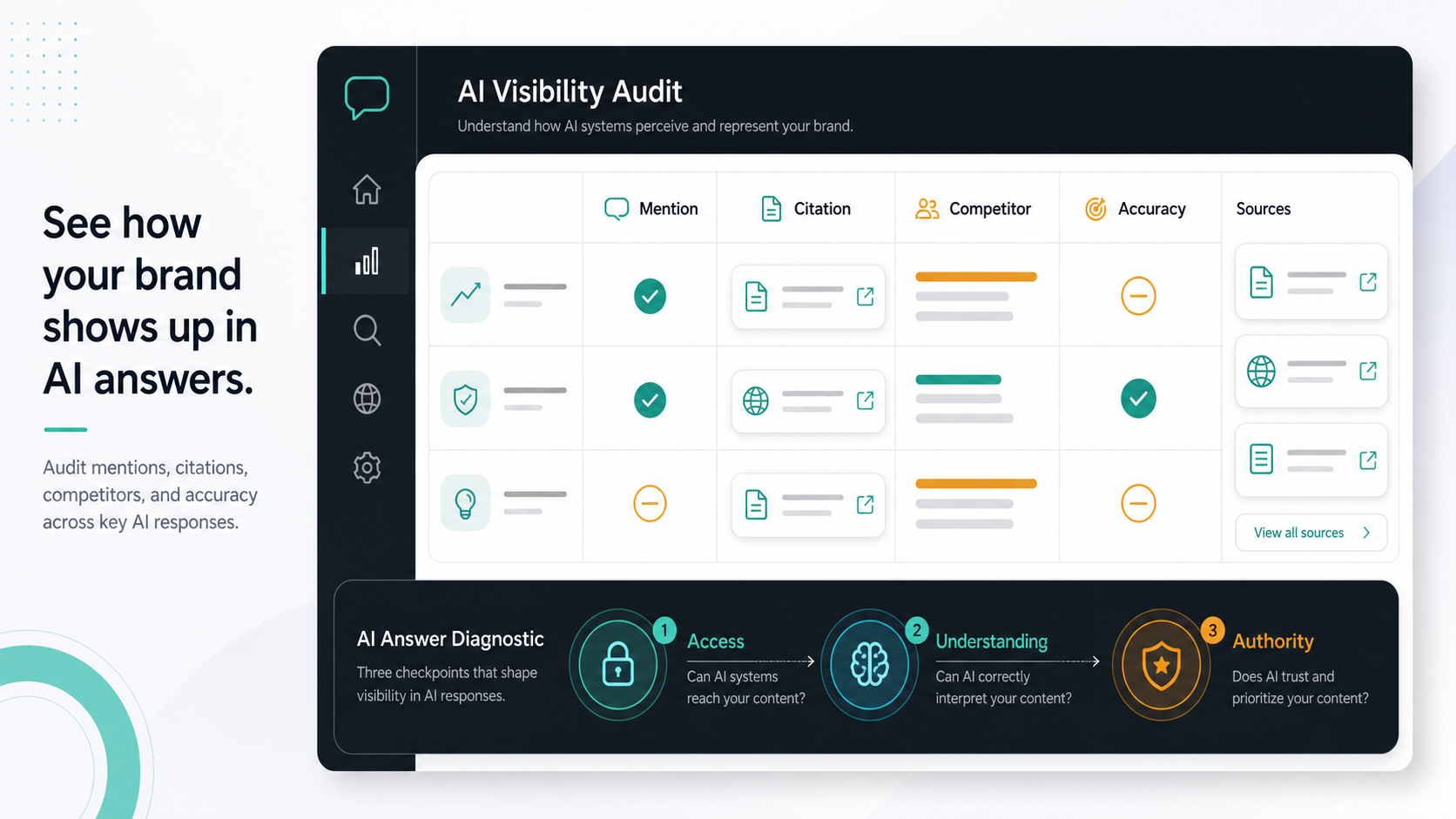
To check if your brand is cited in ChatGPT, do not ask one question and save a screenshot. Run a fixed set of buyer prompts, force or select ChatGPT Search where appropriate, and record four things: whether your brand is mentioned, whether your website is cited, which competitors appear, and whether the answer describes your offer accurately.
That distinction matters. A brand can be mentioned without being cited. A website can be cited without the answer recommending the brand. A competitor can win the answer even when your Google rankings look fine. The goal is not to prove that ChatGPT likes or dislikes you. The goal is to find the visibility gap so you know what to fix.
This guide uses the same diagnostic frame we use in an AI Visibility Audit: access, understanding, and authority. Use it before you rewrite pages, chase random mentions, or buy a tracking tool without knowing what question the tool should answer.
Key Takeaways
- Check ChatGPT visibility across a fixed prompt set, not one branded prompt.
- Track mentions and citations separately.
- Use ChatGPT Search and inspect inline citations or the Sources panel when sources appear.
- If your brand is missing, diagnose access, understanding, and authority before changing content.
- No one can guarantee ChatGPT citations, but you can improve the evidence ChatGPT can find and trust.
What it means for a brand to be in ChatGPT
There are four different outcomes people often collapse into one phrase: "we are in ChatGPT."
| Outcome | What it means | Why it matters |
|---|---|---|
| Mention | ChatGPT names your brand in the answer | You have some entity recognition, but not necessarily source authority |
| Citation | ChatGPT links to your site or a source about you | The answer has retrievable evidence behind the claim |
| Accurate description | ChatGPT explains your category, audience, and offer correctly | The model or search result understands the brand well enough to summarize it |
| Competitor presence | Competitors appear where you do not | The source ecosystem may support them more strongly than you |
A good test records all four. If ChatGPT mentions your brand but cites a competitor roundup, you have a different problem than if ChatGPT never names you. If ChatGPT cites your homepage but describes the business incorrectly, the issue is understanding. If ChatGPT knows your brand in a branded prompt but omits it from category prompts, the issue is usually authority or source coverage.
OpenAI's ChatGPT Search documentation says ChatGPT can search the web when a question benefits from web information and that search responses may include inline citations or a Sources panel: ChatGPT Search. That makes citation checking possible, but it also means the test must capture whether search was actually used.
Build a prompt set before you test
A single prompt is too fragile. Answers can vary by wording, freshness, location context, and whether ChatGPT uses search. Build a small prompt set and reuse it every time.
Start with 12 to 20 prompts across these categories:
| Prompt type | Example | What it reveals |
|---|---|---|
| Branded | "What does [brand] do?" | Whether ChatGPT can describe you accurately |
| Category discovery | "Best [category] companies for [audience]" | Whether you appear when buyers do not know you yet |
| Problem diagnosis | "Why is my company missing from ChatGPT answers?" | Whether your educational content can be cited for buyer pain |
| Comparison | "[Brand] vs [competitor]" | Whether entity and third-party evidence are strong enough |
| Local or vertical | "Best [service] for [industry/location]" | Whether context changes the answer |
| Proof-seeking | "Which sources explain [brand/category] well?" | Whether ChatGPT can find supporting evidence |
Use the same wording, date, account type, location setting, and mode as consistently as possible. If you use ChatGPT Search, note that. If you test without search, note that too. The point is not perfect scientific control. The point is repeatability good enough to detect patterns.
Record mentions, citations, competitors, and accuracy
Create a simple sheet before running the prompts. Each row should be one prompt. Each run should include the date and the ChatGPT mode you used.
| Field | What to record |
|---|---|
| Prompt | Exact wording used |
| Mode | Search, default ChatGPT, deep research, or another mode |
| Brand mentioned | Yes, no, or partial |
| Brand cited | Your site cited, third-party source cited, no citation |
| Cited URLs | Every source URL shown in inline citations or Sources |
| Competitors named | Competitor brands in the answer |
| Competitor URLs | Sources used for competitors |
| Answer accuracy | Correct, incomplete, outdated, or wrong |
| Notes | Anything unusual, such as location influence or missing Sources |
This is where Reddit discussions are useful as buyer-language evidence. In an r/SEO thread about tracking brand visibility in AI search, practitioners debated whether Google rankings are enough and described fixed non-branded question sets as a practical way to see who AI systems mention or cite: Reddit discussion. Treat threads like that as qualitative signal, not as proof of how ChatGPT ranks sources.
After the first run, calculate three basic metrics: mention rate, citation rate, and accuracy rate. If you ran 20 prompts and your brand appeared in two, your mention rate is 10 percent. If your site was cited once, your owned citation rate is 5 percent. If the answer described your offer correctly once, your useful visibility is even lower.
Check whether ChatGPT used search
Do not assume every ChatGPT answer is a live web answer. OpenAI explains that ChatGPT may choose to search the web when current information would improve the response, and users can also select Search directly. When search is used, answers may show inline citations or a Sources panel: ChatGPT Search.
For visibility checks, that creates two useful test modes:
| Test mode | Use it for | What it tells you |
|---|---|---|
| Search-on test | Category, competitor, current, and buyer prompts | Whether your site or third-party sources are retrievable enough to be cited |
| Default answer test | Branded and category knowledge prompts | Whether ChatGPT already has a stable enough understanding of the brand |
If Search is on and your pages never appear, inspect access. OpenAI's crawler documentation says OAI-SearchBot is used to surface websites in ChatGPT search features, while GPTBot is for training and ChatGPT-User is used for certain user-triggered actions: Overview of OpenAI Crawlers. Those are not interchangeable. Allowing or blocking one does not mean the same thing for all ChatGPT experiences.
Also check the boring technical layer: robots.txt, WAF rules, CDN bot controls, noindex tags, canonical tags, server errors, and whether the main content is visible in HTML. A page that blocks the relevant crawler or hides the answer behind fragile rendering is weak evidence.
Diagnose why your brand is missing
Once you have results, sort the problem into access, understanding, or authority.
| Pattern in the test | Likely blocker | What to inspect |
|---|---|---|
| Your site is never cited when Search is used | Access | OAI-SearchBot, robots.txt, WAF/CDN, indexability, canonicals, rendering |
| Your brand is mentioned but described vaguely or incorrectly | Understanding | Homepage, service page, schema, About page, external profiles, naming consistency |
| Competitors are named and cited more often | Authority | Reviews, directories, comparison pages, partner pages, media, Reddit and forum discussions |
| Your brand appears only in branded prompts | Category association | Service page clarity, category language, use-case pages, internal links, third-party category mentions |
| Your educational article is cited but your offer is absent | Conversion path | Links from article to service, methodology, sample audit, and proof assets |
For Uygen, the diagnostic question is whether AI systems can access, understand, and trust the evidence around a brand. That is broader than a content audit. It includes technical access, extractable positioning, structured proof, and the source ecosystem outside your own site.
If the issue is access, rewriting copy is premature. If the issue is understanding, more backlinks will not fix vague positioning. If the issue is authority, another generic blog post may not help because ChatGPT may be relying on third-party sources where your brand is absent.
What to fix first
Prioritize fixes based on the pattern, not on whatever tactic is loudest this month.
| Priority | Fix | Why it comes first |
|---|---|---|
| 1 | Make priority pages accessible | Blocked or unstable pages cannot become reliable sources |
| 2 | Clarify the brand and offer | ChatGPT needs a clean entity, category, audience, claim, and proof |
| 3 | Add citation-ready proof | Methodology, examples, data, FAQs, and sample outputs make pages easier to cite |
| 4 | Strengthen internal paths | Articles should point to the service page, Shopify AI visibility checklist, and Shopify AI visibility tracking guide |
| 5 | Build off-site corroboration | Reviews, directories, partner pages, expert quotes, and community discussions support authority |
| 6 | Re-run the same prompt set | Measurement only matters if it is repeatable |
A practical first pass is to improve one service page, one methodology page, one proof page, and one high-intent article. For a Shopify store, that path is Uygen's monthly SEO + GEO service, which establishes an initial baseline and rechecks the agreed sample monthly and then fixes what it finds by hand, plus articles like how to optimize for ChatGPT Search.
Do not promise guaranteed ChatGPT citations. OpenAI says ranking in ChatGPT Search depends on multiple reliability and relevance factors and that there is no guaranteed top placement. Your job is to improve eligibility and evidence quality, not control the answer.
When to book an AI Visibility Audit
A manual check is enough if the answer is obvious. If robots.txt blocks OAI-SearchBot, fix that. If your homepage never states what the company does, fix that. If all competitors are cited from one directory where you have no profile, fix that.
An AI Visibility Audit is useful when the pattern is mixed or politically hard to interpret. For example: your site ranks in Google but ChatGPT cites competitors; ChatGPT knows your brand but describes it incorrectly; your articles are cited but your service page is invisible; or your team cannot tell whether the blocker is technical, content, or authority.
A credible audit should give you:
- A fixed prompt set across ChatGPT and other AI answer systems.
- Mention, citation, competitor, and accuracy scoring.
- Access checks for priority URLs and crawler policies.
- Entity and page clarity findings.
- Source ecosystem gaps outside your own site.
- A prioritized list of fixes, sequenced by which layer to address first.
That is the practical next step. Do not optimize from a screenshot. Measure the pattern, diagnose the blocker, then fix the evidence. Once you have your initial check results, see how to track AI search visibility over time to build the repeatable measurement system that turns a one-off check into a reliable baseline.
FAQ
How do I check if my brand is in ChatGPT?
Run a fixed prompt set in ChatGPT, including branded, category, comparison, and problem-diagnosis prompts. Record whether your brand is mentioned, whether your site is cited, which competitors appear, and whether the answer is accurate.
What is the difference between a ChatGPT mention and a citation?
A mention means ChatGPT names your brand in the answer. A citation means ChatGPT links to a source. A brand can be mentioned without a citation, and a page can be cited without the answer recommending the brand.
Does allowing OAI-SearchBot guarantee ChatGPT will cite my site?
No. Allowing OAI-SearchBot helps with access for ChatGPT Search, but it does not guarantee placement or citations. OpenAI says there is no guaranteed top placement in ChatGPT Search.
Why does ChatGPT cite competitors but not my brand?
Usually one of three reasons: your priority pages are hard to access, your brand and offer are not clearly described, or competitors have stronger third-party evidence around the category.
How often should I check ChatGPT brand visibility?
For active campaigns, check weekly or monthly using the same prompt set. Record the date, mode, citations, competitors, and answer accuracy so you can compare movement over time.
ChatGPT visibility is not a yes-or-no status. It is a pattern across prompts, citations, competitors, and answer accuracy. Measure that pattern first. Then fix the access, understanding, and authority gaps that keep your brand from becoming reliable evidence.
Run a Shopify store? See what SEO + GEO looks like, done for you.
One flat price covers a monthly audit, on-page fixes, and new articles written for Google and AI answer engines.