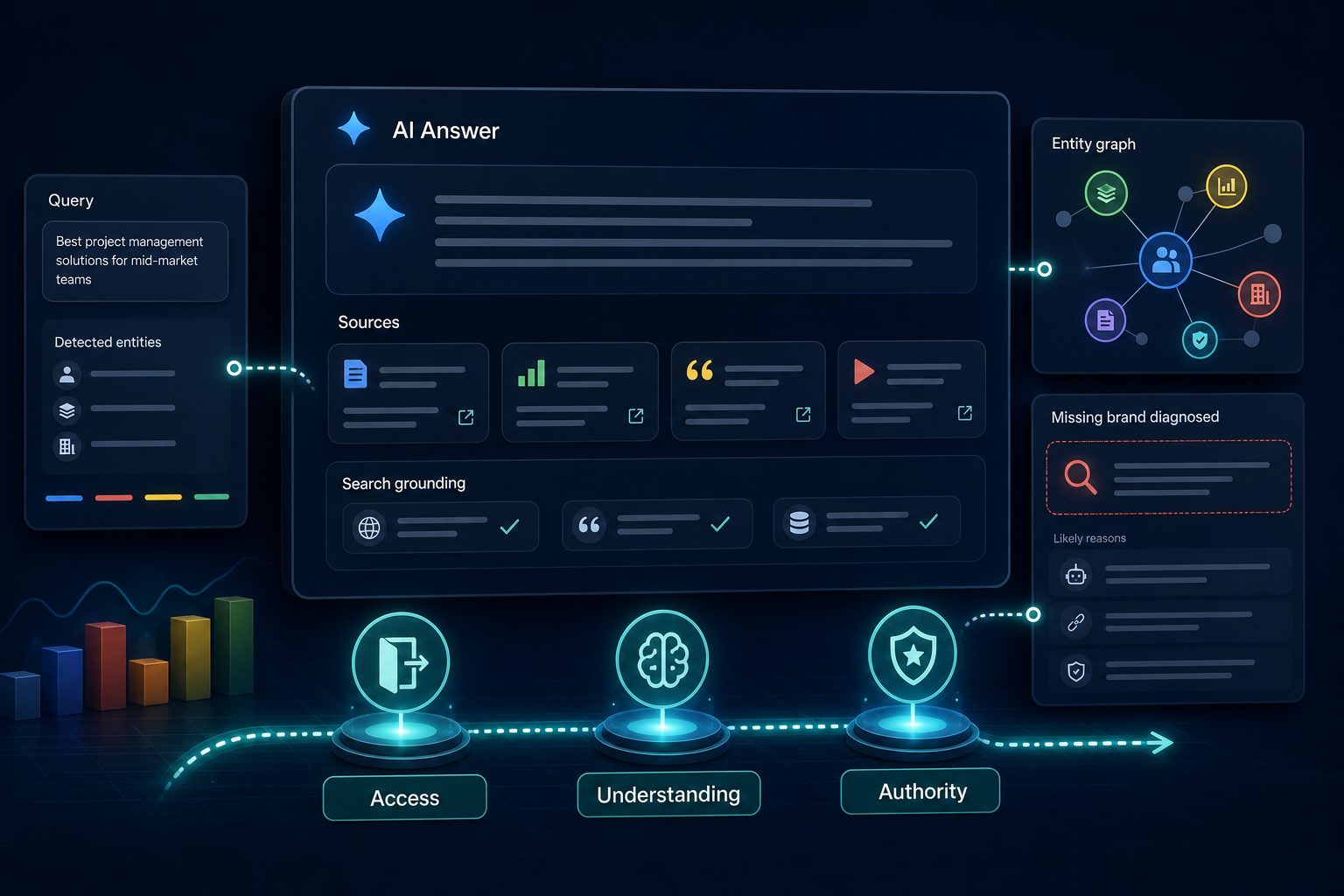
If your brand does not show up in Gemini answers, the problem is usually not one missing blog post. Gemini may lack usable evidence because it cannot access the right pages, cannot understand what your brand should be known for, or does not see enough authority around the claim to use your brand confidently.
That is frustrating for teams that already rank in Google. But Google visibility and Gemini visibility are not the same thing. Gemini answers can involve model knowledge, Google Search grounding, connected apps, user context, and source links that appear only for some responses. A high-ranking page can still be absent, poorly summarized, or outranked by a competitor in the answer.
This guide uses the same Access, Understanding, and Authority frame we use in an AI Visibility Audit. Use it to diagnose the gap before you rewrite your site, add schema everywhere, or ask a vendor to "optimize for Gemini" without knowing which blocker is real.
Key Takeaways
- Gemini visibility depends on usable evidence, not only traditional Google rankings.
- Google says Gemini can ground responses with Google Search, and grounded responses may include source links: Grounding with Google Search.
- Google-Extended is a robots.txt product token that can affect whether crawled content is used for Gemini model training and grounding in Gemini Apps and Vertex AI: Google common crawlers.
- Gemini Apps do not show sources for every response, and a shown link is not always the exact source used to generate the answer: Gemini sources help.
- A credible Gemini strategy measures answer presence, citation presence, and answer accuracy across a fixed query set. It does not promise guaranteed citations or controlled wording.
- Gemini has been measured citing different sources 65% of the time on identical back-to-back queries. Run any Gemini test across at least 10 prompt variations before drawing conclusions.
- Gemini cites Reddit heavily in live search results. ChatGPT and Claude do not cite Reddit at all. Reddit presence is a uniquely useful Gemini signal.
- Google began rolling out a Gemini and Google Business Profile integration globally in mid-2026. GBP completeness and category consistency are now direct Gemini inputs.
- Roughly 90% of Gemini users are on the free tier, which uses live Google Search grounding. Being indexed and crawlable today matters more than training-data presence.
How Gemini actually pulls answers
Gemini does not draw on a single fixed source. When a user asks a question, Gemini may use trained knowledge, live Google Search grounding, connected Google account data, or Google Business Profile data — depending on the product surface, the query type, and whether the model chooses to fire a live search.
The distinction that matters most for brand visibility is between live search grounding and static training knowledge:
| Mode | When it fires | What you can influence |
|---|---|---|
| Live search grounding | Free tier, AI Mode, most factual queries | Indexability, crawlability, freshness, content structure |
| Trained knowledge | Paid Gemini Ultra when it skips live search | Third-party mentions that existed before training cutoff |
Roughly 90% of Gemini users are on the free tier. Free-tier queries with factual intent trigger live search grounding — meaning a freshly indexed, clearly structured page can appear in a Gemini answer within days of being published. Practitioners on r/GeminiAI have documented that paid Gemini Ultra sometimes returns worse answers than the free AI Mode, because AI Mode always fires live search while the chat model occasionally skips it to reduce compute cost. The practical implication: optimizing for the live-search layer covers the large majority of your audience. Chasing training-data presence is speculative and slow.
The second complication is variability. Gemini has been measured citing different sources 65% of the time when asked the same question back-to-back. Claude showed approximately 35% variance; ChatGPT fell in between. A single Gemini test tells you almost nothing. You need a fixed query set run multiple times to establish a meaningful baseline — which is why the query testing step comes before any content changes.
Why Gemini visibility is different from Google rankings
Google rankings tell you whether Google Search can discover, index, and rank a page for a query. Gemini visibility asks a different question: when a user asks an answer engine for advice, does the system have enough usable evidence to mention, describe, or cite your brand?
Those are related, but they are not interchangeable. A page can rank in Google and still be weak evidence for Gemini if the page is vague, blocked from certain uses, hard to extract, unsupported by outside sources, or less useful than competing sources for the prompt.
Google's Vertex AI documentation explains that grounding connects model output to verifiable sources, including Google Search, Vertex AI Search, Google Maps, or private data stores: Grounding API. In practical marketing terms, that means Gemini-related answers may depend on both the model and the retrievable evidence available at answer time.
So the useful question is not, "How do we rank in Gemini?" It is, "Can Gemini access, understand, and trust the evidence that should connect our brand to this buyer problem?"
| Gate | What Gemini needs | Common blocker |
|---|---|---|
| Access | Public evidence can be crawled, indexed, grounded, or retrieved when relevant | Robots rules, Google-Extended policy choices, blocked pages, broken canonicals, weak indexing |
| Understanding | The brand, category, offer, audience, claims, proof, and limits are explicit | Vague positioning, clever copy, hidden answers, inconsistent entity language |
| Authority | The wider source ecosystem corroborates the brand for the topic | Thin third-party mentions, weak reviews, stale profiles, competitor dominance |
Start with a fixed Gemini query set
Do not judge Gemini visibility from one prompt. Gemini answers can vary by wording, location, account context, connected apps, model version, freshness, and whether grounding is used for that response.
Build a fixed query set before you change pages. For a B2B service brand, include at least these prompt types:
| Query type | Example | What it reveals |
|---|---|---|
| Category discovery | "best AI visibility audit companies" | Whether Gemini associates your brand with the buying category |
| Problem diagnosis | "why does my company rank in Google but not show up in Gemini" | Whether your educational content is usable for buyer pain |
| Comparison | "Uygen vs [competitor] for AI visibility audits" | Whether entity data and third-party context are clear enough |
| Methodology | "how do you audit brand visibility in Gemini answers" | Whether your process pages are citation-ready |
| Branded accuracy | "what does Uygen do" | Whether Gemini can describe the brand correctly |
For each query, record whether your brand appears, whether your site or a controlled asset is cited, which competitors appear, which external sources are used, and whether the answer describes the offer correctly. Repeat the same set weekly.
This baseline prevents wasted work. If Gemini describes your brand inaccurately in branded prompts, you likely have an understanding or entity consistency issue. If Gemini knows the brand but never includes it in category prompts, authority may be the bigger blocker. If your priority pages are not accessible or eligible for grounding, access comes first.
Access: make sure Gemini can use the right evidence
Access is the first diagnostic gate because unavailable evidence cannot be cited or summarized reliably. For Gemini, access is more nuanced than "is Googlebot allowed?"
Google's crawler documentation says Google-Extended is a standalone product token. Publishers can use it to manage whether content Google crawls may be used for future Gemini model training and for grounding in Gemini Apps and Grounding with Google Search on Vertex AI: Google common crawlers. Google's AI features documentation also distinguishes Search access from controls for some other Google AI systems: AI features and your website.
That does not mean every missing Gemini answer is caused by Google-Extended. It means teams need to know their policy and its tradeoff. Some publishers intentionally restrict AI training or grounding. Others block or conflict with the relevant access path by accident.
Check these items first:
| Access check | What to verify | Why it matters |
|---|---|---|
| Googlebot access | Priority pages are crawlable, indexable, canonicalized, and returning stable 200 responses | Google Search visibility and many Google AI experiences depend on usable Search infrastructure |
| Google-Extended policy | Your robots.txt reflects an intentional business decision | Blocking may affect Gemini-related training and grounding uses described by Google |
| Page rendering | Core claims and answers appear in crawlable HTML, not only client-rendered fragments | Answer systems need extractable evidence |
| Canonicals and redirects | Canonical tags, redirects, and hreflang point to the right page | Conflicting signals can move evidence away from the intended URL |
| Structured data | Organization, Article, FAQ, Service, or Product schema matches visible content | Schema can clarify entities, but it cannot rescue vague copy |
| Sitemaps and internal links | Priority pages are discoverable from the site architecture | Orphaned proof pages are weaker evidence |
| WAF and consent layers | Google crawlers and normal users can reach the content without broken interstitials | Security layers can make good evidence unusable |
One access channel that became relevant in mid-2026: Google began rolling out a Gemini and Google Business Profile integration globally (excluding EEA/UK). Businesses can connect their GBP to Gemini; Gemini can then draw on Business notebooks as a grounded knowledge base when answering branded queries. If your GBP is incomplete, uses different category language than your website, or has stale hours and descriptions, that inconsistency now feeds directly into Gemini's entity picture of your brand. Treat your GBP as a priority page in any access audit.
A good audit output is a small URL matrix: homepage, offer page, methodology page, sample report, strongest proof page, top comparison page, and the article most likely to answer the target prompt. Mark each one pass, warn, or fail for access.
Understanding: make the brand extractable
Once access is clean, Gemini still has to understand what the brand is, what it offers, who it serves, and why it should be included in an answer.
This is where many marketing sites underperform. They use fluent but ambiguous copy: "unlock growth," "future-proof your strategy," "be visible in AI," or "win the new search landscape." Humans may infer the meaning from context. Retrieval systems need clearer evidence.
A weak sentence says:
"We help ambitious brands win in the age of AI search."
A stronger sentence says:
"Uygen provides an AI Visibility Audit that checks whether ChatGPT, Gemini, Perplexity, and Google AI can access, understand, and trust a brand across its website and source ecosystem."
The second version names the brand, service category, platforms, diagnostic method, and evidence scope. That gives Gemini a cleaner entity and claim to work with.
Use this structure on priority pages:
| Page element | Gemini-friendly version |
|---|---|
| First paragraph | Directly define the brand, offer, audience, and problem |
| H2s | Use descriptive questions and tasks, not clever section labels |
| Proof | Show methodology, examples, findings, screenshots, reports, or customer evidence |
| Tables | Summarize decision criteria, checks, or comparisons in extractable form |
| Limitations | State what the product or audit cannot guarantee |
| Internal links | Connect service, methodology, sample audit, and related problem articles |
One finding that surprises teams used to long-form SEO content: simpler, cleaner pages get cited more than complex ones. Practitioners testing the same queries across Google and AI search consistently find that pages ranking well in Google often do not appear in AI answers, while shorter, more direct pages do. The reason is retrievability. AI search does not reward thoroughness — it rewards how quickly and clearly a page answers the question. Burying the direct answer under three paragraphs of preamble is the most common reason a technically strong page gets ignored by Gemini's retrieval layer.
Do not hide the direct answer under a long narrative. If the page is about why brands are missing from Gemini, say that in the first paragraph. If the page is about an audit, state what the audit checks and what it delivers.
Authority: check whether the wider web agrees
Your site can be clear and accessible but still lose Gemini visibility if the wider web gives stronger evidence for competitors.
Gemini grounding can use public web data when Google Search grounding is enabled: Grounding with Google Search. Gemini Apps can also show related sources and links, though Google says not all responses include sources and a displayed link may not necessarily be what Gemini used to generate the response: Gemini sources help.
That source behavior matters. Your own website is only one part of the source ecosystem. Gemini may lean on review sites, directories, documentation, media coverage, partner pages, comparison articles, community discussions, and other publicly available evidence.
Authority gaps often look like this:
- Competitors are included in roundups, partner pages, category pages, and review ecosystems while your brand is absent.
- Third-party profiles use inconsistent category language.
- Your strongest claims exist only on your own site.
- Reviews or testimonials are thin, stale, or not specific enough to support the category.
- Your brand is mentioned for a broad category but not for the exact buyer problem.
- Your methodology is described internally but not corroborated externally.
One Gemini-specific source pattern worth understanding: Gemini cites Reddit heavily in live search. ChatGPT and Claude do not cite Reddit at all. If you have been building a Reddit presence hoping it would help ChatGPT citations, it has no effect there. But for Gemini, Reddit threads, subreddit discussions, and user-generated comparison posts are active citation candidates because Reddit carries high domain authority and deep Google indexing. For B2C brands, SaaS tools, and service businesses with an identifiable buyer community, this is the most underused Gemini-specific lever available.
Beyond Reddit, the source hierarchy Gemini follows maps closely to Google's: independent sources with high domain authority outweigh your own domain. A large-scale brand analysis found that brands cited consistently by ChatGPT, Gemini, and Perplexity share one pattern — they appear in the same buyer-problem context across multiple independent surfaces simultaneously: G2 reviews, Reddit threads, comparison blog posts, and their own site. A brand with better content but mentions only on its own domain gets skipped. The model treats convergence of independent sources as the signal of authority, not the quality of any single page.
There is also a decay problem: LLM citations drift roughly 40 to 60 percent per month per query. A brand appearing in a Gemini answer for a category query today has statistically a 40 to 60 percent chance of not appearing in that same answer eight weeks from now — without any direct action by you or a competitor. Live search grounding returns different results as new content is indexed, old content ages, and source weightings shift. Static content eventually loses its citation spot. Regular content refreshes, new independent citations, and ongoing profile maintenance are how you hold the citations you have earned.
The fix is not to spam mentions. The fix is to build accurate, consistent, useful evidence where buyers and AI systems already look: partner pages, analyst-style comparisons, directories, profiles, case studies, reviews, integrations, podcasts, webinars, and expert bylines.
What to fix on your site first
If access and authority are not obviously broken, improve the pages that give Gemini the clearest description of your offer.
Start here:
| Priority page | What to improve |
|---|---|
| Service page | State the offer, scope, platforms checked, deliverables, process, and limits |
| Methodology page | Explain how you diagnose access, understanding, and authority |
| Sample audit | Show the format of findings and recommendations |
| FAQ page | Answer buyer objections in plain language |
| Comparison content | Clarify fit and differences without unsupported competitor claims |
| High-intent blog posts | Convert generic advice into diagnostic checklists and examples |
For Uygen, the core path is the AI Visibility Audit, supported by the Shopify AI visibility checklist and Shopify AI visibility tracking guide. The same pattern works for most brands: one page names the offer, one explains the method, and one proves the output.
A Gemini-friendly service page should not promise, "we get you cited in Gemini." It should explain the diagnostic: which prompts are tested, which pages are checked, what source gaps are mapped, and how priorities are chosen.
How to write a Gemini-ready article
If the next asset is an article, write it like a source Gemini could safely use.
Use this checklist:
- Put the direct answer in the first paragraph.
- Use headings that match real buyer questions.
- Name the brand, category, platform, audience, and problem explicitly.
- Include at least one table or diagnostic checklist.
- Link to the official source documents you rely on.
- Link internally to the service page, methodology page, and related problem articles.
- Give examples that show judgment, not just definitions.
- State limitations and avoid guaranteed-answer claims.
- Keep schema aligned with the visible content.
For example, an article about Gemini visibility should not say, "Follow these steps and Gemini will cite your brand." A credible article says, "These checks improve the quality and availability of evidence, but Gemini controls whether and how an answer uses it."
That distinction is important. You control evidence quality. You do not control Gemini's answer.
What not to do
Do not assume Google rankings equal Gemini visibility. Rankings are evidence, not a guarantee.
Do not block or alter crawler policies without understanding the impact. Google-Extended can be a legitimate policy choice, but it should be intentional.
Do not add FAQ schema to vague pages and expect it to solve entity confusion. Schema should clarify visible content, not contradict or replace it.
Do not chase one screenshot. Gemini answers can shift across prompts, accounts, and time.
Do not publish thin "Gemini SEO" posts that repeat generic SEO advice. They rarely add the original evidence that answer systems need.
Do not promise guaranteed Gemini citations, rankings, or answer wording. A credible AI visibility program improves access, clarity, and authority; it does not control the model.
A 30-day Gemini visibility plan
Use the first month to diagnose before scaling content.
| Week | Work | Output |
|---|---|---|
| 1 | Build a fixed Gemini query set and record current answers | Baseline of mentions, citations, competitors, and answer accuracy |
| 2 | Audit access for priority URLs | Robots, Googlebot, Google-Extended, status, canonical, rendering, sitemap, and internal-link findings |
| 3 | Rewrite key pages for extractability | Clearer brand definition, direct answers, proof blocks, tables, and aligned schema |
| 4 | Map authority gaps and begin first citations | Missing third-party sources, reviews, profiles, partner pages, directories, and comparison opportunities. Audit Google Business Profile for completeness and category consistency; connect the GBP notebook. Identify 3 to 5 Reddit threads or comparison pages where a genuine brand mention is appropriate. |
The order matters. If Week 2 shows access conflicts, fix those before rewriting every article. If Week 1 shows Gemini knows your brand but not your category, clarify entity language and source consistency. If competitors dominate every non-branded prompt, authority work may matter more than another blog post.
How to measure progress
Measure Gemini visibility by query and answer behavior, not by a single win.
Track these fields:
| Metric | What to record |
|---|---|
| Mention presence | Whether your brand appears in the answer |
| Citation presence | Whether your site or controlled asset is linked when sources appear |
| Answer accuracy | Whether Gemini describes your category, offer, and audience correctly |
| Competitor presence | Which competitors appear and how they are described |
| Source mix | Which external sources, directories, reviews, or articles appear |
| Prompt sensitivity | Whether small wording changes remove or add your brand |
| Fix history | Which access, content, schema, or authority changes happened before movement |
One important calibration: expect 40 to 60 percent citation variance month over month as the baseline. A single week where your brand does not appear is not a signal worth acting on. A consistent absence across five or more query runs is. Conversely, appearing once in a Gemini answer is not a stable position — it is a starting point. Track mention rate as a percentage of query runs, not as binary present or absent, and look for directional trends over 90-day windows rather than weekly snapshots.
Do the same across ChatGPT, Perplexity, Google AI Overviews, and Gemini. The pattern matters more than one platform snapshot. For the Google ranking version of the same problem, see why you rank in Google but do not appear in ChatGPT. For a competitor-focused version, see why competitors show up in ChatGPT but your brand does not.
When an AI Visibility Audit is the better first step
If you already know the blocker, fix it. But if your team is unsure whether Gemini visibility is limited by access, unclear positioning, weak source authority, or competitor evidence, an audit is usually the lower-risk first step.
A useful audit should show:
- Which Gemini prompts mention, cite, omit, or misdescribe the brand today.
- Whether priority pages are crawlable, indexable, and eligible for the relevant Google AI uses.
- Whether service, methodology, proof, and comparison pages are extractable.
- Which competitors and third-party sources appear instead.
- Whether entity language is consistent across the brand site and external profiles.
- What to fix first over the next 30 to 90 days.
That is the practical path. Improve the evidence before you scale the content.
FAQ
Why does my brand show up in Google but not Gemini?
Google rankings and Gemini answers use related but different systems. A ranking page may still be weak evidence if it is vague, poorly supported, hard to extract, blocked from certain uses, or less authoritative than competing sources for the prompt.
Does blocking Google-Extended affect Gemini?
Google says Google-Extended lets publishers manage whether crawled content may be used for future Gemini model training and for grounding in Gemini Apps and Grounding with Google Search on Vertex AI: Google common crawlers. Whether to allow or block it is a business policy decision, but it should be intentional.
Can I guarantee Gemini will cite my brand?
No. You can improve access, clarity, and authority, but Gemini controls when it uses sources, which links appear, and how answers are worded.
What should I check first if Gemini gets my brand wrong?
Start with branded prompts, then inspect your homepage, service page, organization schema, external profiles, review sites, directories, and third-party mentions for inconsistent category language or outdated descriptions.
Is Gemini optimization the same as SEO?
It overlaps with SEO, but it is not identical. SEO focuses heavily on ranking pages in search results. Gemini optimization focuses on whether answer systems can access, understand, trust, and use the evidence about your brand.
Does Google Business Profile affect Gemini answers?
Yes, since mid-2026. Google began rolling out a Gemini and Google Business Profile integration globally (excluding EEA/UK). Businesses can connect their GBP and Gemini can draw on it as a grounded knowledge base when answering branded queries. An incomplete or inconsistent GBP — different category language from your site, stale hours, missing description — can introduce entity conflicts that affect how Gemini describes your brand in answers.
Why does Gemini cite Reddit but not my own pages?
Gemini's live search grounding follows Google's indexing signals. Reddit carries high domain authority and is deeply indexed by Google, so Gemini frequently surfaces Reddit threads. ChatGPT and Claude do not cite Reddit at all. If Gemini is surfacing Reddit discussions about your category but not your own site, the likely causes are that your priority pages are harder to extract than the Reddit content (dense structure, buried answers) or that your domain has not yet built enough authority to outweigh Reddit for the target queries.
Gemini visibility is not a mystery channel. It is evidence work. Make the right pages accessible, make the brand and offer easy to understand, and build corroboration outside your own site. Then measure the same prompts over time.
Run a Shopify store? See what SEO + GEO looks like, done for you.
One flat price covers a monthly audit, on-page fixes, and new articles written for Google and AI answer engines.