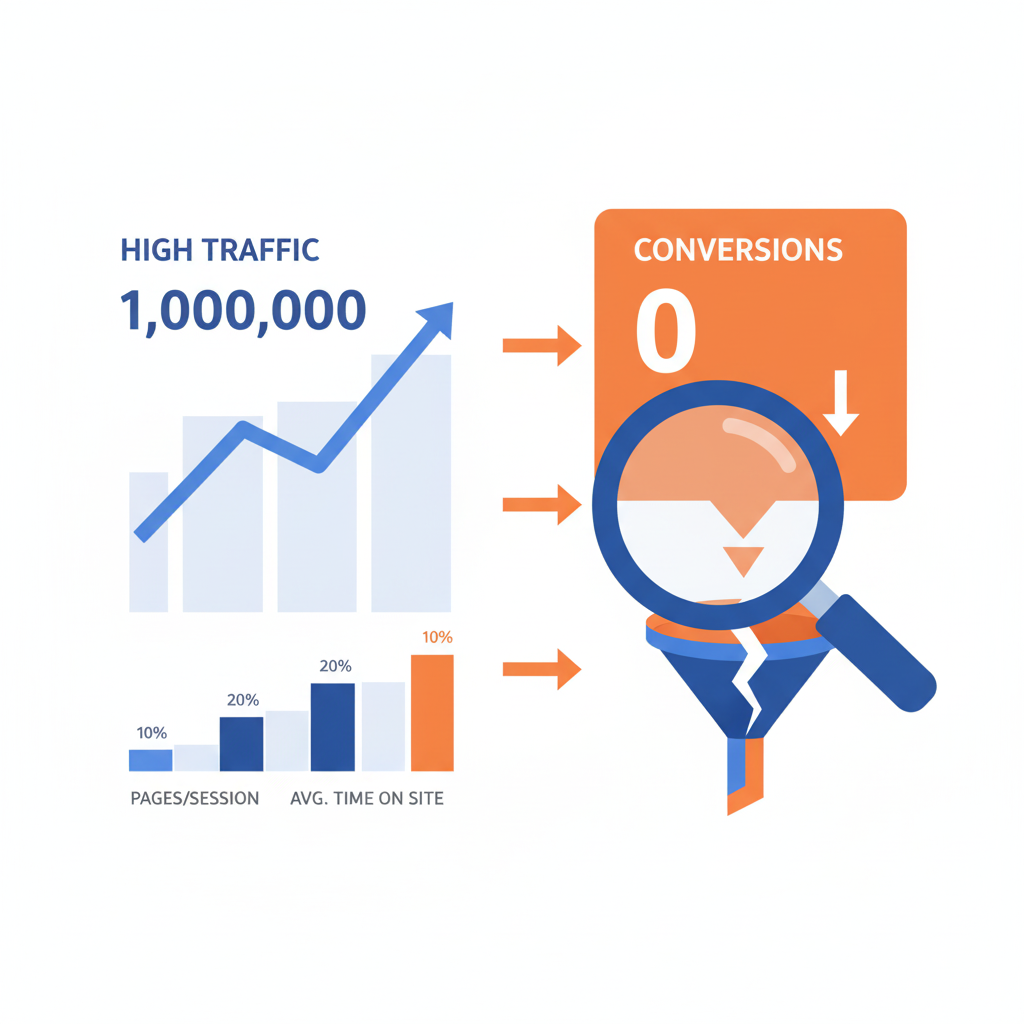
You check analytics and see sessions rising, but the phone is quiet, the inbox is empty, and no one is requesting an audit. That usually means you do not have a traffic problem. You have a conversion problem.
Traffic only proves that people found the page. Conversion proves the page made them trust you enough to act. When one goes up without the other, something on the page is failing in the gap between interest and action.
This guide breaks that gap into seven common leaks. It also gives you a quick self-audit you can run on your highest-traffic pages. If your team already suspects content quality or structural issues, our SEO content audit framework is the broader version of the same diagnostic logic.
Key Takeaways
- → High traffic with weak lead generation usually signals a page problem, not a reach problem.
- → Intent mismatch, weak CTAs, and missing trust signals are usually the highest-leverage fixes.
- → Pages should guide visitors from problem to proof to action without forcing them to guess the next step.
- → Informational SEO traffic is useful, but it needs a stronger bridge into service and audit pages.
What "not converting" actually means
On a lead generation website, a conversion is any action that moves a visitor closer to becoming a customer: a form submission, a booked conversation, an audit request, or a direct inquiry.
Traffic measures discovery. Conversion rate measures whether the page turned that discovery into a useful next step. A page can attract attention and still fail commercially if it does not persuade the right visitor to act.
The benchmark: what a healthy conversion rate looks like
Many B2B websites convert only a small percentage of visits, which is normal. What matters is whether important commercial pages consistently generate qualified actions. If the pages that drive the most traffic produce almost no leads, you likely have a structural leak, not just a bad week.
Conversion leak #1: intent mismatch
The most common problem is not design. It is intent mismatch. The page ranks for visitors who want information, but the page asks them to take a commercial action they are not ready for yet.
Search engines reward pages that match query intent. If a page ranks for high-volume, top-of-funnel questions, those visitors usually want education first. Asking them to request a service immediately often underperforms because the page is solving the wrong stage of the journey.
How to spot an intent mismatch in analytics
Look at your top traffic pages in GA4 and Search Console, then compare them against the query types that drive visits. If the queries are mostly "what is," "how to," or other educational searches, your page may need a better bridge into a commercial next step rather than a harder CTA.
This is also where your content mix matters. Top-of-funnel posts should hand readers into service pages, comparison pages, or audit pages. If you want the broader AI-search version of this issue, our GEO guide and Google AI Overviews guide explain why ranking visibility alone is no longer enough.
If your site gets search traffic but the wrong pages are doing the work, start with Audit before publishing more content. The priority is fixing the conversion path, not just increasing sessions.
Conversion leak #2: weak or generic CTAs
A CTA is a directional instruction. When it is vague, visitors hesitate. "Contact us" says what to do, but not what the visitor gets or why they should act now.
What a strong lead generation CTA looks like
Strong CTAs are specific, outcome-focused, and connected to the problem the page just described. "Request a free audit" is stronger than "learn more" because it reduces ambiguity and makes the value visible.
- → Use one primary CTA per page.
- → Place it above the fold, once in the body, and again near the end.
- → Tie the CTA to a clear result, not a generic action.
Conversion leak #3: poor internal page flow
Visitors need a clear sequence: confirm relevance, understand the problem, see the solution, trust the source, then act. If the page jumps around or forces them to work too hard, they leave.
The above-the-fold test
In the first few seconds, a visitor should know what the page is about, whether it applies to them, and what to do next. Vague headlines, giant hero images, and buried calls to action create friction before trust has even started.
Internal links are part of this flow too. A blog post should not end in a dead end. It should move visitors into the next relevant page, whether that is a service, a deeper guide, or an audit path.
Conversion leak #4: trust gaps
Before someone shares contact details, they need to believe two things: that you understand the problem and that you are credible enough to help solve it. If the page offers neither proof nor reassurance, hesitation wins.
The minimum trust stack for a lead generation page
- → Specific testimonials or result statements, not generic praise.
- → Recognizable proof such as client logos, examples, or concrete outcomes.
- → Clear ownership: who wrote this, who delivers the work, and why they are credible.
- → Basic safety signals such as HTTPS, privacy language, and visible recency.
If your trust layer is thin, the problem is rarely solved by a new button color. It usually needs sharper positioning, better page structure, and stronger proof on the page itself.
Conversion leak #5: slow load speed and weak mobile UX
Speed is not just an SEO metric. It is a conversion variable. If the page is slow on mobile, loads unstable layouts, or makes forms hard to complete, visitors drop before they ever evaluate your offer.
How to check your site speed right now
Run your key pages through PageSpeed Insights and then test the actual mobile experience by hand. Look for slow hero images, layout shift, overloaded scripts, and forms that feel annoying on a small screen. Conversion friction often shows up as a user experience failure before it shows up as a ranking failure.
Conversion leak #6: optimized for bots, not buyers
There is a growing gap between content that ranks and content that persuades. A page can be technically optimized, keyword-rich, and crawlable while still failing to move a human reader toward a decision.
How generative search changes the conversion equation
AI-generated answers absorb more informational intent at the search layer. That means top of funnel visibility is less reliable as a conversion engine on its own. Pages increasingly need to do one of two things well: win citation visibility or win buyer action after the click.
That is why we separate the work into diagnosis and production. The audit identifies where your current pages fail. Once the diagnosis is clear, you can decide whether the fix is a rewrite, a new page, a CTA change, or a proof problem. If you want the AI-search side of this shift, start with our ChatGPT search guide .
Conversion leak #7: no lead capture for visitors who are not ready yet
Most visitors will not request a service on their first visit. If your only path is "fill out this form now," you lose everyone who is interested but not ready.
Simple lead nurture tactics that recover lost pipeline
- → Offer a lower-friction next step such as a checklist, guide, or sample.
- → Use email follow-up or retargeting so visitors are not lost after one session.
- → Give content readers a commercial bridge into service pages when they are ready.
Need a faster answer than trial and error?
Use the audit to diagnose whether the issue is intent mismatch, weak trust, weak flow, or the wrong page entirely before running another redesign cycle.
How to run a quick conversion audit on your own site
You do not need a full agency engagement to diagnose the basics. Start with your five highest-traffic pages and run this checklist.
5-question self-audit checklist
- 1 Does the page match the intent of the queries that drive traffic to it?
- 2 Is there one clear, specific CTA with an obvious visitor benefit?
- 3 Can a stranger verify your credibility in under 30 seconds?
- 4 Does the page load cleanly and work comfortably on mobile?
- 5 Does the page guide a first-time visitor toward the right next step?
Use GA4 for page-level conversion events, Search Console for query patterns, and heatmaps or session recordings to find engagement drop-offs. If the self-audit shows gaps but not the root cause, that is usually the point where a structured audit becomes more efficient than guessing.
Once the diagnosis is clear, the fix usually falls into one of two buckets: improve the existing page or create a better page. The important part is getting the diagnosis right before changing layouts, copy, or offers at random.
Frequently asked questions
Why is my website getting traffic but no conversions?
The most common causes are intent mismatch, weak CTAs, poor page flow, missing trust signals, or slow mobile performance. High traffic with low conversions usually points to a page-level conversion problem, not a visibility problem.
What is a good website conversion rate for lead generation?
A healthy B2B lead generation website often converts around 2 to 3 percent of visits, with stronger commercial pages sometimes going higher. If important pages sit below 1 percent, something structural is usually wrong.
How do I fix my website conversion rate?
Start with your highest-traffic pages and audit them for intent alignment, CTA clarity, page speed, trust signals, and internal flow. Fix the biggest leak first so you can measure what actually improved results.
What causes high bounce rates with no conversions?
High bounce rates usually come from intent mismatch, a weak above-the-fold section, slow load time, or a page that does not immediately confirm relevance. Visitors leave when the page creates friction before trust is established.
How do I know which pages have the worst conversion leaks?
Use GA4 and Search Console together. Pages with strong traffic but weak conversion events are your first targets. Heatmaps and scroll data can then show where engagement drops and where the leak is most likely happening.
Traffic without conversions is a useful signal. It means people are finding you, but the page is not closing the trust and decision gap.
Start by fixing the one or two leaks with the biggest impact. If you want a faster path, use the AI Visibility Audit to identify what is broken first so the traffic you already have has a better chance to convert.
If the problem is not conversion but visibility — rankings, indexing, or AI Overviews — the starting point is different. Read Why Your SEO Is Not Working for the ranking and indexation triage.