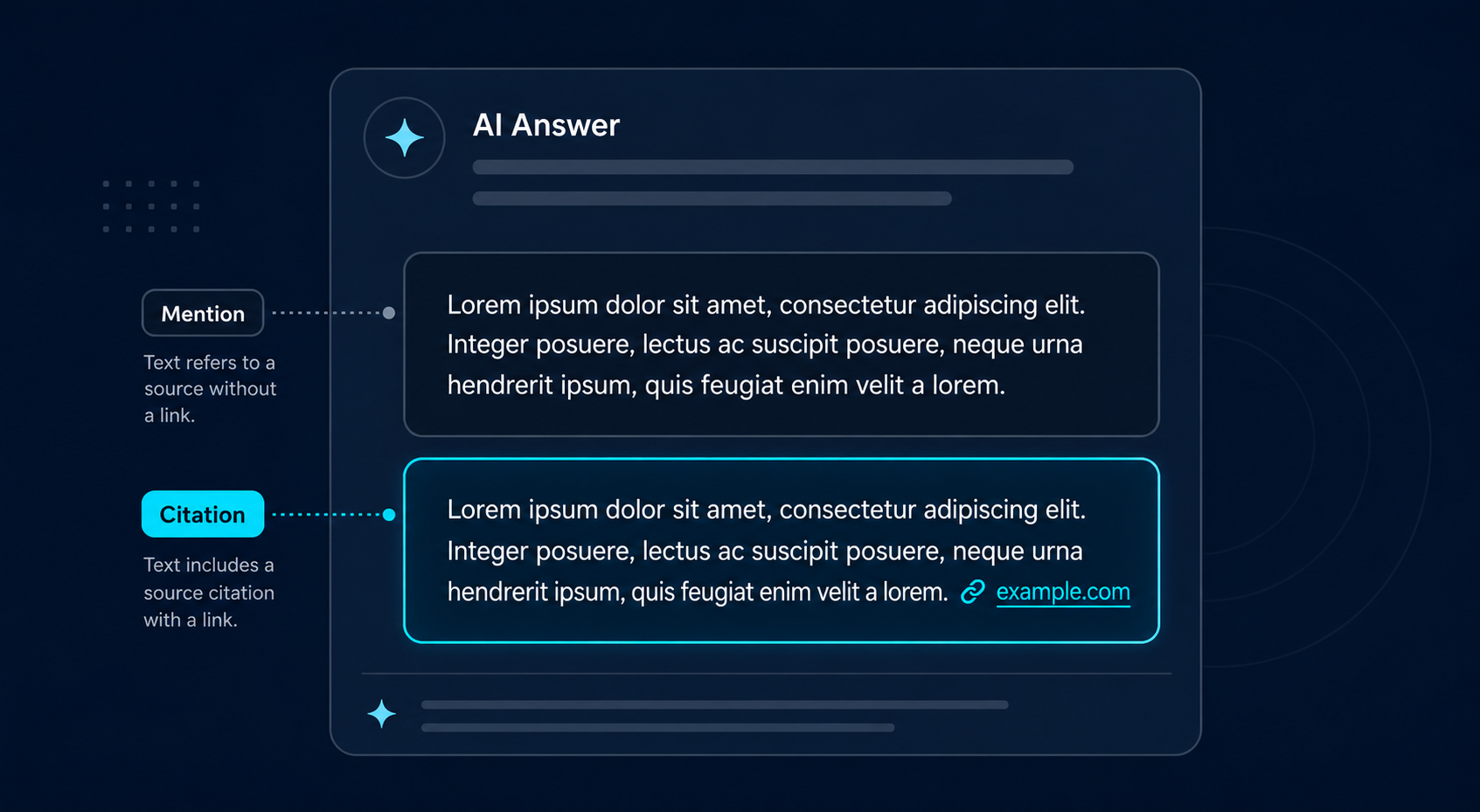
Quick answer: Citation share is the percentage of AI-generated answers in which your brand is cited as a source — with a URL attached. It differs from a mention (your brand name appears in the answer text but no source link) and from Share of Model (any brand appearance in any form). Bing Webmaster Tools now reports citation share natively under AI Performance, making it the first free tool to track this metric.
Key takeaways
- Citation is not the same as mention. Citation share counts URL-attributed appearances only. A mention is when your brand name appears in an AI answer but no source link is attached.
- Citation share and Google rank are not correlated. A page at position 11 can be a top-cited asset on Perplexity. 88% of Google AI Mode citations are not in the top 10 organic results.
- Bing WMT reports it for free. The Bing Webmaster Tools AI Performance dashboard is the only free citation share tool available. Google Search Console does not report AI citations.
- It is an off-site metric. Citation share is built through entity authority: independent third-party references, structured content, and vocabulary alignment. On-page SEO alone cannot move it.
- Low citation share points to one of three gates: Access, Understanding, or Authority.
Most marketing teams are tracking the wrong signal. They watch organic rankings in Google Search Console, monitor share of voice in media reports, and measure page-level traffic. None of it tells them whether AI systems are citing their brand when buyers are actively researching a decision.
Citation share is the metric that does. It measures the percentage of AI-generated answers in which your brand is cited as a source, with a URL attached. Bing Webmaster Tools began reporting it natively in June 2026, making it the first platform to offer a free, structured citation share report.
This article explains what citation share measures, how it differs from related metrics like Share of Model and share of voice, and what a low score means about your brand's AI visibility.
Citation share vs mention vs Share of Model: the key difference
Citation share counts only URL-attributed source appearances in AI-generated answers. Not every appearance counts.
Three distinct terms describe how a brand shows up in an AI answer:
| Term | What it measures | URL required? |
|---|---|---|
| Mention | Your brand name appears in the answer text | No |
| Citation | Your brand's URL appears as a cited source | Yes |
| Share of Model (SoM) | Any brand appearance, text mention or URL citation | No |
Share of Model is the broader metric: the percentage of AI-generated answers where your brand appears in any form. Citation share is a sub-metric of SoM. It counts only the appearances where an AI engine has attached your URL as a source. Some practitioners use the term Share of Citation interchangeably — it describes the same URL-attributed measurement.
The distinction matters because citations carry a different signal than mentions. A citation means the AI system treated your content as reliable enough to surface as evidence. A mention means your brand name appeared in the answer, but the engine did not point a source link at your site. On Perplexity, where nearly every answer includes source URLs, the difference between being cited and being mentioned is the difference between driving traffic and not.
Why citation share matters more than organic rank
A page at position 11 on Google can have higher citation share on Perplexity than a page at position one. Practitioners have confirmed this in live data.
One SEO practitioner tracking AI citations alongside traditional rankings found that an article at position 11 was "one of my best-performing assets on a channel I had not been measuring at all" when checked for Perplexity citations. Multiple commenters across r/seogrowth and r/digital_marketing independently confirmed the same pattern.
The structural reason: 88% of Google AI Mode citations do not appear in the top 10 organic SERP results. Ranking and citation share are measuring different access paths. A brand can rank on page one and have near-zero citation share. A brand can sit off the first page and be regularly cited by AI engines that trust its content.
Organic rank reflects how Google's link-based index scores a page. Citation share reflects whether AI systems treat that content as a reliable source to hand to a user. Different judgements, different systems, different signals.
How citation share is measured
Citation share is now measurable through Bing Webmaster Tools (Microsoft's free website performance platform) and manual prompt testing.
Bing Webmaster Tools: the free citation share report
Bing Webmaster Tools added four metrics to the AI Performance dashboard in June 2026:
- Citation Share — your site's percentage of all citations for a given grounding query
- Intents — classifies the queries that lead to your citations by intent type
- Topics — groups related grounding queries into thematic clusters, the way AI systems actually reason
- Compare — overlays a prior time period to show citation trend
A grounding query is the user's original search that triggers an AI-generated answer. Bing groups these into Topics to show citation share at a thematic level, not just query by query.
The report is framed as observational. It does not expose competitor domains and is not a ranking scoreboard. It is the only free tool currently reporting this data. Google Search Console does not report AI citations, and Bing WMT shows AI citations that will never appear in GSC. For any brand working on AI visibility, Bing is now the more useful measurement starting point.
Manual measurement with a fixed prompt set
Bing WMT covers Bing Copilot only. For broader platform measurement:
- Build a fixed prompt set of 10 to 20 queries covering the category questions your buyers actually ask.
- Run each prompt on Perplexity. It cites URLs on nearly every answer, making citation share directly visible.
- Log for each answer: brand URL cited (yes/no), which competitor URLs appeared, answer accuracy.
- Calculate citation share per platform per week.
- Repeat weekly using the same session structure to track trends.
Perplexity is the highest-measurability platform for manual tracking because it attaches source URLs by default. ChatGPT often names brands without attaching URLs, making citation share harder to count. Track it as mention rate instead.
Paid AI visibility tools
For brands that need automated, cross-platform tracking: Semrush AI visibility, AthenaHQ, Otterly, and Profound each offer structured citation share reporting. Ahrefs has added AI citation tracking. Coverage is uneven for niche industries, but branded query tracking is confirmed useful across tools. Related metrics such as Share of Answer track similar AI visibility dimensions — Unusual Ventures covers the full metric landscape in detail.
How citation share differs by AI platform
Citation share behaves differently on each AI platform because each has a different citation architecture.
Perplexity attaches source URLs to nearly every answer. It is the highest-measurability platform. Citation share is directly visible in the answer UI and relatively consistent.
ChatGPT tends to mention brands in answer text without attaching a source URL. Citation share is lower even when brand appearances are high. Tracking here is more accurately described as mention rate.
Bing Copilot reports citation share natively through Webmaster Tools. It is also testing reduced clickability on citation links, where only the small marker at the end of a line is clickable rather than the full linked text. If this rolls out widely, brand citation without referral traffic becomes the structural norm, reinforcing citation share as the correct primary metric over click volume.
Google AI Overviews tie citations to the organic index. The access path is different from Perplexity or Bing Copilot, and Google does not currently offer citation share reporting in Search Console.
Gemini citation frequency varies by query type. Factual, definitional queries generate more source citations than conversational queries.
What drives citation share
Citation share is built off-site, not on-site. This is the most commonly misunderstood part of the metric.
Improving citation share requires entity authority — the combination of three factors:
1. Independent credible sources referencing the brand. Reddit threads, G2 reviews, LinkedIn mentions, comparison blogs, and industry publications are the source types AI systems most commonly cite. A brand that exists only on its own website has thin entity authority. A brand with a consistent presence across third-party sources that AI systems crawl has strong entity authority.
2. Structured content AI systems can extract. Pages with clear definitions, quotable factual claims, and structured data are more likely to be cited than pages where the same information is buried in narrative prose. AI systems cite content they can extract and verify.
3. Brand vocabulary aligned with LLM category terms. Citation share is influenced by how well a brand's language maps to the terms large language models associate with its category. Content that uses recognizable category vocabulary gets surfaced. Content that drifts from that vocabulary does not.
Practitioners who have improved citation share consistently report the same finding: brand citations inside AI answers drive downstream branded search even without a click. That lift appears in brand search volume weeks before it appears in referral traffic. Citation share is a pipeline metric. It signals whether buyers in the research phase are encountering the brand before they click anything.
What low citation share signals
Low citation share is a symptom, not a diagnosis. Three root causes account for most low citation share situations.
Access. AI systems cannot reach the evidence. The brand's content may be blocked to crawlers, missing structured data, lacking an llms.txt file, or simply absent from the third-party platforms AI systems crawl. A brand missing from Google AI Overviews often has an access problem, not a content problem.
Understanding. AI systems cannot extract a clear answer from the content. Pages that discuss a topic without stating a clear position, defining key terms, or including quotable factual claims are unlikely to be cited. The engine needs a sentence it can surface as an answer.
Authority. Third-party sources do not independently support the brand's claims. Even well-structured, accessible content has low citation share if no independent source references it. AI systems preferentially cite brands that appear across multiple independent sources, not only on their own site. This is why brands can rank on Google but not appear in Gemini or ChatGPT. Google rewards on-site signals. AI systems reward off-site presence.
If your citation share is low and you cannot identify which gate is limiting it, an AI Visibility Audit maps the gap across all three dimensions and returns a prioritised fix roadmap. Low citation share also isn't evenly distributed: some categories skew far more toward third-party sources than others. See the brand vs. referee citation split by industry for the data on which categories you're up against.
FAQ
What is citation share in AI search?
Citation share is the percentage of AI-generated answers in which your brand's URL appears as a cited source. It measures URL-attributed appearances only, not brand name mentions in the answer text. Bing Webmaster Tools now reports citation share natively under AI Performance.
How is citation share different from Share of Model?
Share of Model counts any brand appearance in an AI answer, text mentions and URL citations alike. Citation share counts only URL-attributed citations. Citation share is a sub-metric of Share of Model. A brand can have high Share of Model and low citation share if AI systems mention it by name but do not attach source links.
What counts as a citation vs a mention in an AI answer?
A citation is when an AI engine attaches your URL as a source in the answer, visible as a source link or numbered reference. A mention is when your brand name appears in the answer text but no source link is attached. Perplexity cites with URLs on nearly every answer. ChatGPT most often mentions without citing.
How do I check my citation share for free?
Open Bing Webmaster Tools and navigate to AI Performance. Citation Share shows your site's percentage of all citations for your tracked grounding queries. For other platforms, build a fixed prompt set and run it on Perplexity weekly, logging whether your URL appears as a cited source on each answer.
Does Bing Webmaster Tools show citation share?
Yes. Bing Webmaster Tools added Citation Share to the AI Performance dashboard in June 2026. It shows your site's percentage of citations for given grounding queries, grouped by Topics and compared across time periods. It is the only free tool currently offering this data. Google Search Console does not report AI citations.
Why does my brand rank on Google but have low citation share?
Organic rank and AI citation share measure different things. Google ranks pages using link-based and on-page signals. AI systems cite sources based on entity authority: independent third-party references, structured extractable content, and vocabulary alignment with LLM category terms. A brand can rank top 10 in Google and still have near-zero citation share if its off-site presence is thin.
Citation share is the closest thing to a direct measurement of AI brand visibility that exists today. Bing Webmaster Tools made it free and native in June 2026. The brands that start tracking it now, and identify which of the three gates (access, understanding, authority) is limiting their score, will have a measurable lead over those still relying on rankings and share of voice.
If your citation share is low and you do not yet know why, an AI Visibility Audit maps the gap across all three gates and returns a prioritised fix list.
Low citation share and not sure which gate is blocking you?
The AI Visibility Audit diagnoses whether the problem is access, understanding, or authority — and returns a prioritised fix roadmap so you know exactly where to start.