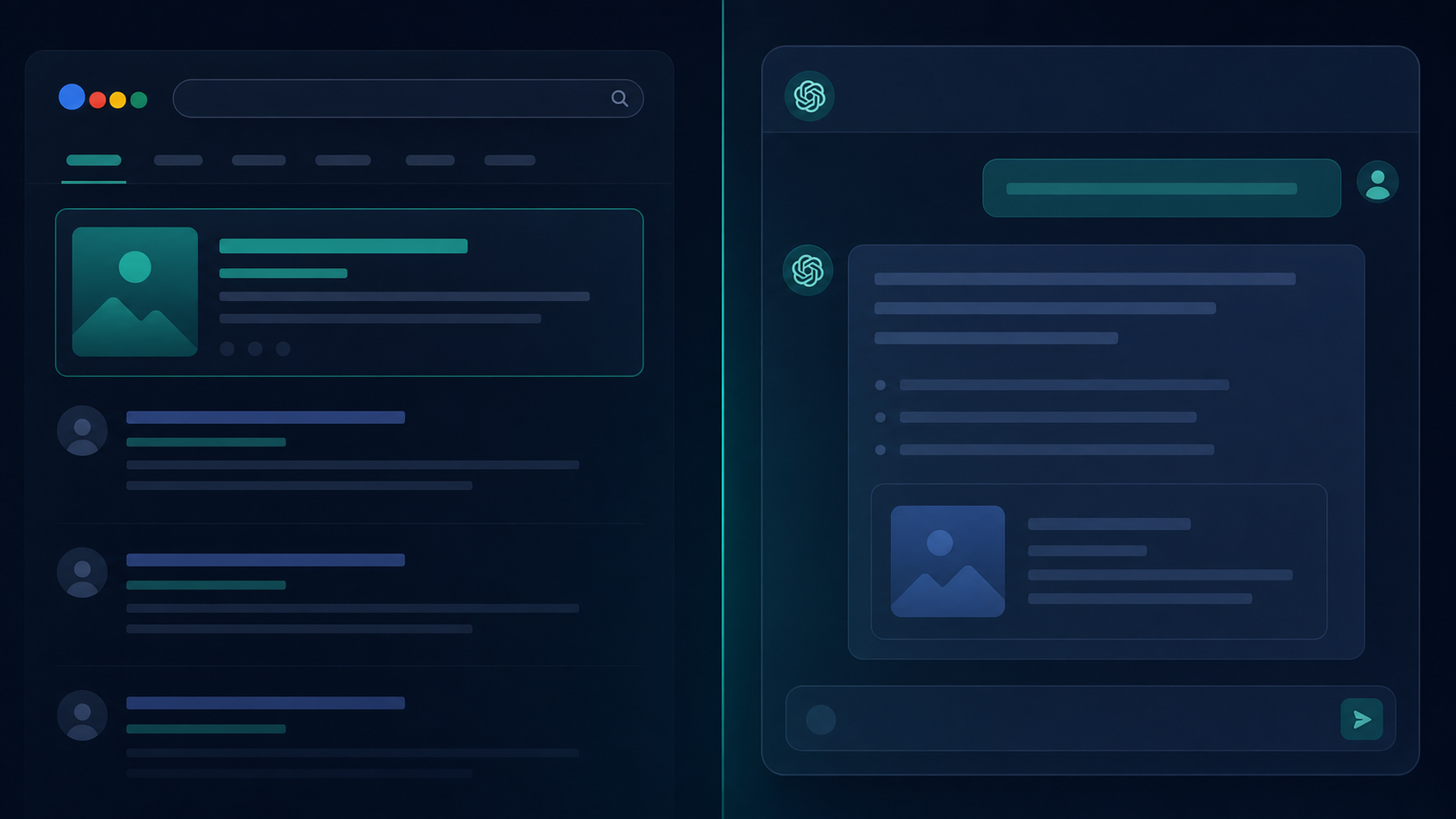
Your brand ranks on Google. The SEO report is clean. But when someone asks ChatGPT or Perplexity about your category, competitors appear and you don't.
This is not an SEO failure. It's an AI visibility gap — and it's more common than most marketing teams realize. This post explains what an AI visibility audit is, what it actually checks, and whether you need one.
This is the informational guide. If you already understand the problem and want to see how Uygen's monthly Shopify SEO + GEO service handles it end to end, visit the service page .
Teams usually investigate this category when ChatGPT, Perplexity, Gemini, or Google AI Overviews mention competitors, skip their brand, or describe the offer incorrectly.
Key Takeaways
- → Google rankings and AI citations are separate systems; strong SEO does not transfer automatically to AI visibility.
- → Strong SEO brands appear in only 18% of relevant AI answers on average.
- → An AI visibility audit checks three layers: Access, Understanding, and Authority.
- → It is not an SEO audit, not a tool report, and not a citation guarantee — it is a diagnostic and a prioritized roadmap.
- → The clearest signal you need one: run buyer-intent prompts in ChatGPT and Perplexity. If competitors appear and you don't, the gap is real. Not sure how? Start with how to check if your brand appears in Perplexity.
How the monthly Shopify service works
Month 1 establishes the baseline while fixes and publishing begin. Later months recheck store health, verify previous changes, and investigate priority issues rather than repeating the full onboarding audit. A person reviews every fix and each of the three weekly articles before publication.
A defined visibility sample
At onboarding, we agree a fixed set of buyer questions, competitors, markets, platforms, and runs per question. We rerun it monthly using a repeatable collection process and human review. We distinguish branded accuracy from unbranded discovery and report mentions, recommendations, citations, and factual accuracy separately by platform. Testing conditions, unavailable results, and sample changes are recorded. These observations describe the sample, not the whole market; completed work is reported separately from visibility changes. Third-party review starts with sources in those answers. Deeper investigation is prioritized within the agreed scope.
What fixes and articles cover
Access work includes internal links, supported visibility settings, and readable product information. Understanding work clarifies product facts, suitability, policies, and supported schema settings; articles answer buyer questions. Authority work strengthens claims with attributable expertise and documented evidence where available, while identifying gaps in independent corroboration. Articles support both Understanding and Authority, but publishing volume does not create independent reviews or coverage.
Where implementation stops
Included fixes use existing Shopify content fields and settings. Custom Liquid or theme development, app installation, infrastructure changes, external outreach, and third-party placements are excluded. We document issues beyond scope and recommended next steps. Completion time depends on the issue and access required; a completed fix does not guarantee indexing, citations, or revenue.
Why does my brand not appear in ChatGPT or AI search?
Google rankings and AI citations run on different systems with different optimization requirements. A brand can hold top-3 Google positions for every major service keyword and still be completely invisible in ChatGPT, Perplexity, and Google AI Overviews.
Data from a 1,200-query study across multiple LLMs found that strong SEO brands appear in only 18% of relevant AI answers — local businesses as low as 9%.
A cleaning company in Dubai makes the problem concrete: 15-year-old brand, top-3 Google rankings for most services, invisible in all AI answers. Practitioners identified three root causes — a 30% 301 redirect rate burning AI bot crawl budget before reaching key service pages, content framing around "wellness" rather than the specific cleaning services people were querying, and no explicit service schema. None of those were SEO problems. All of them were AI citation problems.
The root causes group into three categories:
If the gap is specific to Google's generated results, start with why content is missing from Google AI Overviews . For a broader breakdown of why SEO performance doesn't translate to AI citation, see Your SEO Audit Says Everything Is Fine. Why Are You Still Missing From ChatGPT? and Why Competitors Show Up in ChatGPT But Your Brand Doesn't .
What is an AI visibility audit?
An AI visibility audit is a structured diagnostic that checks whether AI systems can access, understand, and trust your brand — and identifies which layer is the actual bottleneck blocking citations.
It is not an SEO audit with a new name. SEO audits check ranking signals: technical health, backlinks, keyword targeting, Core Web Vitals. An AI visibility audit checks citation signals: whether AI systems can reach your pages, extract useful answers from them, and find enough independent corroboration to surface your brand in a response.
The two overlap in some areas — indexing matters for both, content quality matters for both — but they diverge on the signals that actually move citations. A site can be technically clean for SEO and still have critical AI visibility blockers that no SEO audit will flag.
What does an AI visibility audit actually check?
The audit runs across three layers. A detailed breakdown of all seven components is in What an AI Visibility Audit Includes .
Access: can AI systems reach your content?
The access check confirms that AI crawlers can physically reach and index your priority pages:
- → AI crawler permissions — are GPTBot, ClaudeBot, PerplexityBot, and Google-Extended explicitly allowed in robots.txt, or blocked by default or legacy rules?
- → Bing indexing — 88.46% of ChatGPT cited pages come from Bing's index. If a page isn't in Bing, it is effectively invisible to ChatGPT's web retrieval regardless of its Google ranking.
- → CDN and bot protection — Cloudflare and similar platforms silently block AI crawlers on approximately half of all sites through WAF or bot-fight rules, with no robots.txt entry and no visible error.
- → Redirect chains — high 301 redirect rates burn AI bot crawl budgets before they reach key pages.
- → Rendering — single-page applications return blank HTML to bots; AI agents read HTML, not JavaScript.
Understanding: can AI extract a useful answer?
Even when AI crawlers reach your pages, they need to extract a clear, useful answer:
- → Content extractability — do pages open with a direct answer, or is the key information buried in paragraph six?
- → Heading structure — are H2s phrased as questions AI systems are actually asked?
- → Schema and structured data — does structured markup accurately reflect visible page content?
- → Entity clarity — does the site consistently describe what the brand does, who it serves, and where it operates?
Authority: do independent sources corroborate your brand?
AI systems triangulate across independent sources to decide whether a brand belongs in a response. The authority check maps:
- → Which third-party platforms reference your brand (review sites, directories, publications, Reddit)
- → Whether competitors have a materially stronger off-site citation footprint
- → Whether sources AI systems weight most heavily — Wikipedia, Reddit, established media — mention your brand at all
- → Source-confusion risk: if AI associates your brand name with a competitor's positioning, that is an authority problem, not an access problem
Prompt testing across AI platforms
The audit includes live prompt testing across ChatGPT, Perplexity, Gemini, and Google AI Overviews for category queries, service queries, and competitor comparison queries. This is what automated tools cannot replicate — it shows how your brand actually appears (or doesn't) in the responses real buyers receive.
Who needs an AI visibility audit?
Strong fit:
- → Brands with established SEO presence that are invisible or misrepresented in AI answers for their core category
- → Marketing teams seeing organic traffic decline despite stable or improving Google rankings
- → Brands where competitors consistently appear in AI answers for queries the brand should own
- → CMOs being asked to report on AI search performance and having no data to present
The clearest signal: run three to five buyer-intent prompts in ChatGPT and Perplexity for your category. If competitors appear consistently and you don't, the gap is real and measurable. Search Engine Journal's CMO audit guide outlines the key questions to ask when evaluating your AI search presence.
Less urgent:
- → Brands with no AI-surface competitors yet in their category
- → Early-stage sites with thin content and basic indexing gaps — fix those first
One thing worth noting: AI visibility gaps don't appear in Google Analytics. They don't register as lost sessions. They register as pipeline that never arrived — buyers who formed a shortlist in ChatGPT before ever reaching a search results page.
What an AI visibility audit is not
Not a guarantee of AI citations.
AI systems decide independently what to cite. An audit identifies what is blocking citations and what to prioritize fixing — it does not promise placement. See What an AI Visibility Audit Cannot Guarantee for the full scope.
Not an SEO audit renamed.
The checks are different, the signals are different, and the output is different. An AI visibility audit doesn't replace an SEO audit — it addresses the gap that SEO audits were never designed to find.
Not a tool report.
Automated tools can check whether your robots.txt allows AI crawlers and whether your pages are Bing-indexed — Ahrefs and Semrush both publish free DIY checklists for these technical checks. A professional audit adds prompt-level testing across AI platforms, competitor citation gap analysis, and a prioritized roadmap — work that requires judgment, not just a scan.
What happens after the audit?
The audit delivers:
| Deliverable | What it covers |
|---|---|
| Top blockers | Specific technical, content, or authority issues preventing AI citation |
| Top 3 priorities | Ranked by impact and fix difficulty |
| Competitor citation gap map | Which competitors appear where you don't, and why |
| Prompt test results | How your brand appears across ChatGPT, Perplexity, Gemini, Google AI Overviews |
| Prioritized next steps | Sequenced by which layer to fix first |
We prioritize by buyer relevance, evidence, severity, and effort. Findings feed into included fixes and content; issues requiring custom development or infrastructure work are documented for your developer. We report completed work separately from observed changes in the monthly sample.
Run a Shopify store? See what SEO + GEO looks like, done for you.
One flat price covers a monthly audit, on-page fixes, and new articles written for Google and AI answer engines.
Frequently asked questions
What is an AI visibility audit?
An AI visibility audit is a structured diagnostic that checks whether AI systems can access, understand, and trust a brand — and identifies which of those three layers is blocking citations. It covers AI crawler access, Bing indexing, content extractability, schema, entity clarity, off-site citation sources, and live prompt testing across ChatGPT, Perplexity, Gemini, and Google AI Overviews.
How is an AI visibility audit different from an SEO audit?
An SEO audit checks ranking signals: technical health, backlinks, keyword targeting, Core Web Vitals. An AI visibility audit checks citation signals: whether AI systems can reach your pages, extract useful answers, and find independent corroboration of your brand. A site can pass an SEO audit and still have critical AI visibility blockers — Bing indexing gaps, CDN bot-blocking, content framing mismatches, and off-site authority gaps — that traditional SEO tooling never flags.
Can I run an AI visibility audit myself?
Partially. You can check robots.txt AI crawler permissions, verify Bing indexing, and run manual prompts in ChatGPT and Perplexity. What requires professional judgment: interpreting prompt test patterns across multiple platforms, mapping the competitor citation gap, identifying content framing mismatches, and building a prioritized roadmap based on which layer is actually the bottleneck.
Who needs an AI visibility audit?
Brands with established SEO presence that are invisible or poorly represented in AI answers are the strongest fit. The clearest signal: run buyer-intent prompts in ChatGPT and Perplexity. If competitors appear consistently and you don't, the gap is real. AI visibility gaps don't appear in Google Analytics — they show up as pipeline that never arrives.
What happens after an AI visibility audit?
It depends on who ran it. A standalone audit hands you a prioritized list of blockers and leaves the fixing to you. Uygen's monthly Shopify SEO + GEO service folds the audit into ongoing delivery: top blockers and priorities feed directly into that month's hands-on fixes and weekly articles, tracked in one monthly report. Month 1 establishes the baseline; later months verify previous fixes and rerun the agreed sample. Implementation time depends on the issue and access required. Custom development and infrastructure changes are outside scope.
An AI visibility audit is not a prediction of where AI will cite your brand. It is a diagnostic of what is currently preventing it — and a roadmap for what to fix first.
If competitors appear in AI answers for queries your brand should own, the gap is findable, measurable, and fixable. For Shopify stores, Uygen's monthly SEO + GEO service establishes the baseline and rechecks priorities every month and then does the fixing and publishing, not just the diagnosis.