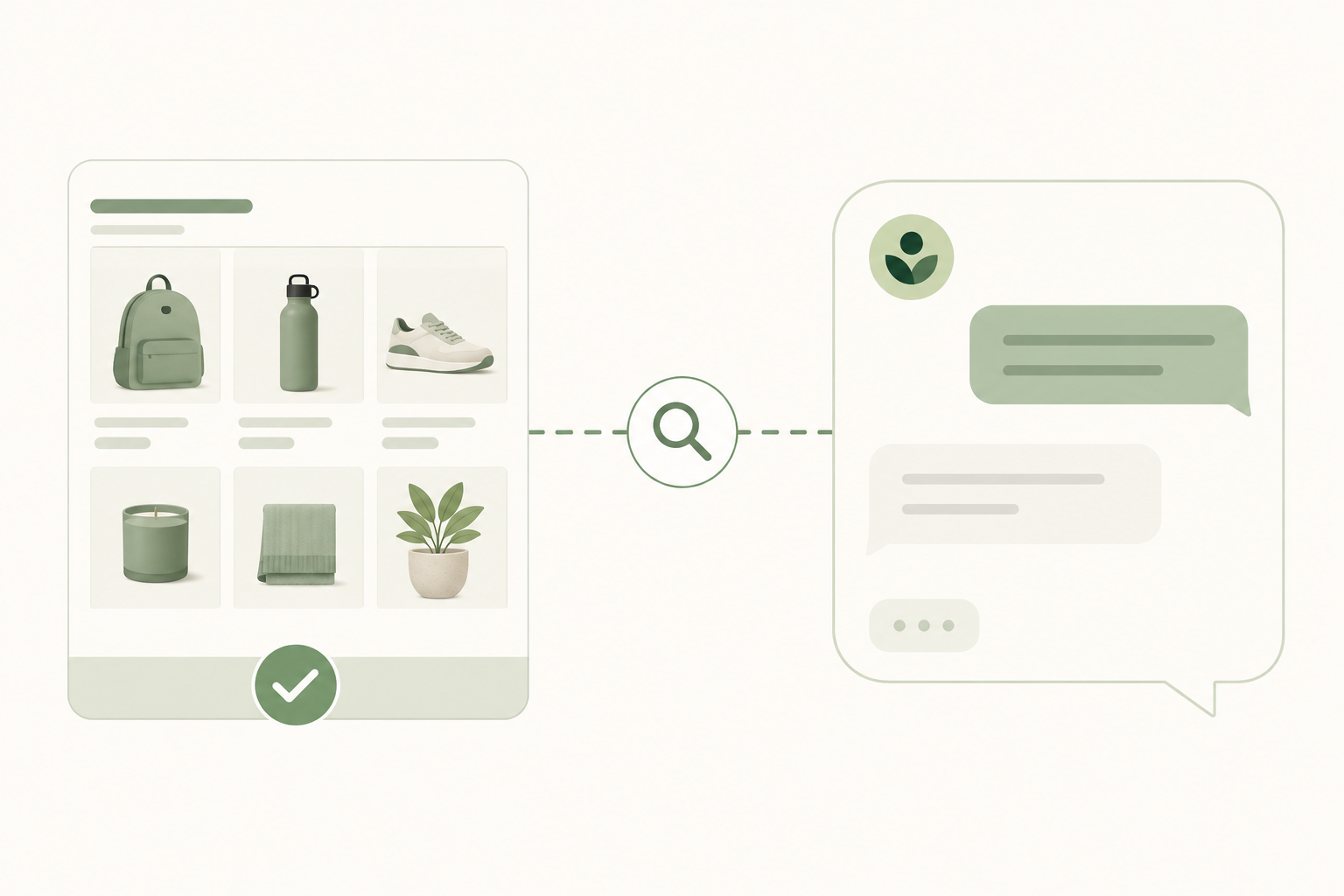
Quick answer: Tracking AI visibility for a Shopify store means measuring two separate systems: whether products are listed in ChatGPT Shopping's product feed, and whether the brand is recommended in conversational answers. Use Search Console's Web performance report (Google reports AI Overview and AI Mode traffic within overall Web search, not as a separate filter), Bing Webmaster Tools' AI Performance report, and Google Merchant Center's AI Performance Insights to measure each, since no single tool covers both and installing a paid app is not required to start.
Key takeaways
- "Listed in ChatGPT Shopping" and "recommended by ChatGPT" are two different systems: one is a feed and data-quality problem, the other is a third-party-presence problem.
- Google Merchant Center's new AI Performance Insights report is a free, native way for ecommerce brands to see AI share-of-voice, if you already sync a feed there.
- llms.txt has no measured effect on AI citation across 300,000 domains. Don't prioritize it.
- GA4 needs a manual custom channel group to catch AI referral traffic; it doesn't separate it by default.
Most Shopify AI-visibility advice skips a distinction that actually matters: showing up in ChatGPT Shopping and getting recommended by ChatGPT are two different systems, built on two different kinds of data. A store can have a spotless product feed and still never get mentioned when a shopper asks "what's the best [category]?" Or the reverse: a store with a messy feed still gets named conversationally because of strong brand presence elsewhere. Most Shopify apps sold as "AI visibility trackers" report one blended number that implies it covers both. It doesn't.
This guide shows you how to track AI visibility for your Shopify store by separating the two systems, using a mostly-free measurement approach (Google Search Console, Bing Webmaster Tools, Google Merchant Center, and a properly configured GA4), and explaining why being listed but never recommended is usually a brand-presence problem, not a technical one.
Listed vs. recommended: the two systems you're actually tracking
ChatGPT Shopping and ChatGPT's conversational brand recommendations run on different inputs, so a Shopify store can score well on one and be invisible on the other. For the general cross-platform version of this framework, see our AI search visibility measurement playbook; this guide applies it specifically to Shopify.
Being listed in ChatGPT Shopping
Listing is a data-quality problem, not a brand problem. ChatGPT Shopping pulls directly from a product feed, and Shopify syncs stores into it through Agentic Storefronts and Catalog (Shopify's product-feed sync mechanism for AI shopping surfaces), comparable to how Google Shopping reads a Merchant Center feed. A product with a vague title, missing price, or no availability data simply doesn't have enough structure to be listed reliably.
Being recommended in conversational answers
Recommendation is a different, harder system. When a shopper asks ChatGPT something like "what's the best running shoe brand for flat feet," the answer draws on training data plus live search index results, not the product feed. StoreRank.ai's 2026 integration guide notes that getting listed is comparatively easy; getting recommended is where most stores fail, because it depends on brand signals outside the store's own site.
Track these two things separately. A single blended "AI visibility score" from a third-party app hides which of the two problems you actually have.
Track whether you're listed in ChatGPT Shopping
Checking listing status means auditing your product feed data and, if you already sync to Google Merchant Center, reading its new AI Performance Insights report.
Start with the feed itself. Review a sample of products for descriptive (not just branded) titles, current price and availability, and complete Product schema (JSON-LD). These are the fields Shopify's Agentic Storefronts reads to decide whether a product is eligible to be surfaced at all.
If your store already syncs a feed to Google Merchant Center (most Shopify stores running Google Shopping ads do), check the AI Performance Insights report (Merchant Center's AI-visibility reporting feature). Google launched this in 2026 specifically for ecommerce brands: it shows share-of-voice inside AI Mode, AI Overviews, and the Gemini app, mapped across discovery, evaluation, and purchase stages, and benchmarks you against similar brands. It's currently a US pilot with wider rollout planned, and it's free if you already have a Merchant Center account. No separate AI-tracking subscription is needed for this half of the picture.
Track whether you're recommended in conversational AI answers
Checking recommendation status means manually testing your category's top prompts and logging what gets cited, because the two engines pull from different indexes and neither rewards feed data alone.
Run your top 15-20 category prompts directly in ChatGPT and Perplexity, with web search turned on, and log which brands and sources actually get cited. Ahrefs' analysis of 1.4 million prompts found that only about 17% of the URLs ChatGPT cites appear anywhere in Google's organic results for that same query — 83% have no traditional Google visibility at all. That means conversational recommendation runs on a largely separate index, not something you can infer from Google rankings alone. Perplexity works differently: it leans more on Bing's index alongside real-time Reddit scraping.
Ranking well on Google isn't sufficient on its own, either: a separate Ahrefs study found only about 12% of links cited across ChatGPT, Gemini, and Copilot actually rank in Google's top 10 for the same prompt. What predicts citation share more reliably is third-party presence. Position Digital's 2026 study found Reddit's share of ChatGPT's cited sources grew roughly 30x in a single month, while formal review content (the format most brands invest in heaviest) carries only about 1.6% of citation share. If your prompt-testing log keeps turning up the same few competitor threads or listicles, that's the actual gap to close, not your product pages. See our citation share explainer for how this metric works across engines.
Set up a measurement stack that actually separates AI traffic
A working measurement stack needs a GA4 custom channel group for AI referrers, Search Console's Web performance report, and Bing Webmaster Tools' AI Performance report (a free query-intent and share-of-voice breakdown Search Console doesn't offer natively). None of these require a paid app.
Google Analytics 4 doesn't separate AI-platform traffic by default; most of it lands under Direct or generic Referral because ChatGPT's mobile app and Perplexity's in-app browser frequently drop referrer data. Conversios' setup guide walks through creating a custom channel group with a regex rule matching chatgpt.com, chat.openai.com, perplexity.ai, claude.ai, and gemini.google.com, placed above the default Referral rule so it actually catches the traffic.
Check Search Console's Web performance report regularly: Google reports AI Overview and AI Mode traffic within the overall Web search type rather than as a separate filter, so there's no dedicated AI toggle to turn on. Watch overall impression and click trends as one directional signal, and pair them with manual prompt sampling to confirm whether AI surfaces are actually citing your pages. Then set up Bing Webmaster Tools' AI Performance report, which breaks down query-intent categories, topic clusters, and share of voice, and it matters because Perplexity and Bing Copilot both draw on Bing's index.
Does llms.txt actually help you get tracked or cited?
No. An analysis of 300,000 domains found llms.txt (a proposed AI-crawler instructions file) has no measurable effect on AI citation frequency, so it shouldn't be a priority.
Plenty of Shopify apps sell llms.txt generation as an AI-visibility fix. The data doesn't support it. SE Ranking's study of 300,000 domains found no measurable link between having an llms.txt file and how often a site gets cited by AI systems, and adoption is already low: roughly 10% of indexed domains and effectively 0% among the top 1,000 sites by traffic. Search Engine Journal's coverage of the same study notes that structured data types (FAQPage, Organization sameAs, ClaimReview) correlated with citation far more strongly than llms.txt did.
If a Shopify AI app's main pitch is llms.txt generation, that's not where the leverage is. Clean Product schema and third-party presence are.
What to do if you're listed but never recommended
A store that's listed but never recommended almost always has an authority gap, not a technical one, so the fix is rarely another feed tweak.
Run the diagnosis in three layers:
Access. Can AI crawlers and shopping agents actually reach your store? Check for a Cloudflare rule or robots.txt line quietly blocking OAI-SearchBot, GPTBot, or PerplexityBot.
Understanding. Is your product data structured well enough to be parsed and listed reliably? This is the feed-quality work from the section above.
Authority. Is there anything about your brand outside your own website? This is usually the real gap. A store can be technically flawless and still be invisible in conversational recommendations if competitors dominate the Reddit threads, listicles, and reviews that ChatGPT actually cites for that category. The third-party presence data above is the evidence for this.
For the full self-check across all three layers, see our Shopify AI visibility checklist. Most Shopify AI-visibility tools only tell you whether you're showing up, not which of these three layers is broken. That diagnosis is what a Shopify AI Visibility Audit is built to do, worth a call once your own tracking shows a real gap, rather than guessing at fixes.
FAQ
Is being listed in ChatGPT Shopping the same as being recommended by ChatGPT?
No. Being listed means your products appear in ChatGPT Shopping's transactional feed, which is a data-quality problem solved through Shopify's Agentic Storefronts and clean product data. Being recommended means ChatGPT names your brand in a conversational answer, which depends on training data, live search results, and third-party presence like Reddit mentions and reviews. A store can be strong in one system and absent from the other.
Does my Shopify store need Google Merchant Center to show up in AI search?
Not strictly, but it helps if you're already running Google Shopping ads. Stores syncing a feed to Google Merchant Center can use its AI Performance Insights report, a free, native view of brand share-of-voice inside AI Mode, AI Overviews, and Gemini. Stores without Merchant Center can still track AI visibility through Search Console's Web performance report (Google folds AI Overview and AI Mode traffic into overall Web search rather than breaking it out as a separate filter), Bing Webmaster Tools' AI Performance report, and manual prompt testing.
Is llms.txt worth setting up for a Shopify store?
Based on the current evidence, no, not as a priority. A 300,000-domain study found no measurable link between llms.txt and AI citation frequency. Structured data types like FAQPage and Organization sameAs schema correlated with citation far more strongly, so that's where the effort is better spent.
How do I track ChatGPT and Perplexity referral traffic from my Shopify store?
GA4 doesn't separate this traffic by default. Set up a custom channel group with a regex rule matching chatgpt.com, chat.openai.com, perplexity.ai, claude.ai, and gemini.google.com, placed above the default Referral rule. ChatGPT reliably appends a utm_source parameter to some outbound links; Perplexity, Gemini, and Claude generally don't, which is part of why AI traffic often shows up as Direct without this setup.
Why does a competitor with worse Google rankings get recommended more often in ChatGPT?
Usually because they have stronger third-party presence: more Reddit mentions, more listicle placements, more reviews cited by name, not because of anything technical on their site. Only about 12% of AI-cited links actually rank in Google's top 10 for the same prompt — and most of what ChatGPT cites has no Google visibility for that query at all. Presence outside your own website is what closes that gap.
Treat AI visibility as two scores, not one. Listing status is a feed and structured-data problem you can fix directly in Shopify. Recommendation status is mostly a third-party presence problem, closer to PR and community work than to technical SEO. Start with the free native tools (Google Search Console, Bing Webmaster Tools, and Merchant Center's AI Performance Insights if you have it) before paying for another dashboard that blends both numbers into one that doesn't tell you which is actually broken.
If your own tracking turns up a real gap and you're not sure which layer it's coming from, that's the point to book a Shopify AI Visibility Audit rather than guessing at fixes.
Not sure whether the gap is listing or recommendation?
The AI Visibility Audit tests both systems directly — your product feed eligibility and your conversational citation rate — and maps the source-ecosystem gap behind whichever one is broken.